


Entertainment
Savitha Sastry: Narrating a modern story in an ancient art form
Jun 14, 201201:52 PM
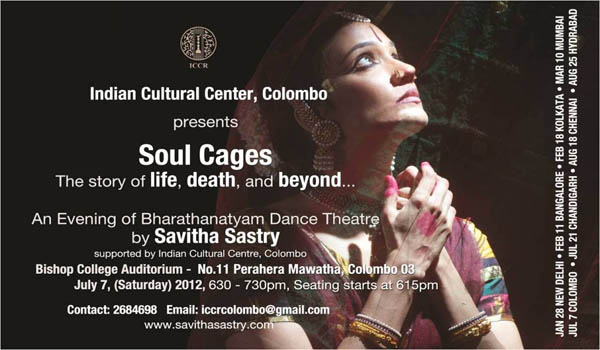


‘Flowing elegance, breathtaking, moves like a temple sculpture come to life’ said the San Francisco Voice of Savitha Sastry. Danseuse Sastry is a leading advocator of Bharthanatyam, the classical Indian dance form hailing from Tamil Nadu and rooted in ancient history.
‘Soul Cages’ is her second production, which she has performed to great acclaim in New Delhi, Bangalore, Kolkata and Mumbai. She will be performing ‘Soul Cages’ at the Bishops College Auditorium in Colombo on Saturday, July 7, 2012. Admission, as always, will be free: she has never danced for financial gain.
An extremely talented danseuse, Savitha Sastry stands apart even amongst her most talented peers with her combination of perfect techniques and innovative spirit. She is that rare artiste who wins over both the purist and the not-conversant. She has the ability, according to A.K. Srikanth, the author of ‘Soul Cages’, to “bring any story to life when she steps underneath the spotlight.”
Sastry is deeply grounded in the Bharthanatyam tradition but in keeping with her goal of taking the art form to a much wider and more diverse audience, she imbues it with meaning that is relevant in this present age without losing its aesthetic and cultural integrity. As a solo dancer she is a pioneer in using the Bharthanatyam form to create new choreographies and narratives, allowing the modern viewer to connect with the entire performance. The result of her pioneering spirit is proof that Bharthanatyam is indeed a universal art form that can be appreciated by one and all.
Her effortlessness and grace originate from a disciplined practice of yoga. Hard work and constant training is requisite from any Bharthanatyam dancer. This rigorous discipline she imbues with her daring for improvisation, enthralling audiences in India and abroad.
Savitha’s path to glory
Savitha Sastry had figured out what she wanted to do in her life – her ‘passion’ as she calls it rather than her profession - pretty early on, at the age of five to be precise, when she paid 25 paise to the maid to playact a Bollywood dance sequence with her.
Growing up in Mumbai, like all other Indian children her age, Savitha was a Bollywood fan, especially the dance sequences, better known as item numbers. Her favourites were those starring popular star-actors Dharmendra and Hema Malini - hardly classical choices. Sastry’s then place of residence happened to be situated across the Shanmukananda Hall, the famous cultural hub of Indian classical events. Her interest in dance saw her drawn towards it like ‘a moth to light’ as she took in the many great dancers’ performances there.
Her official journey as a dancer however began when she was six years old, when she began to learn Bharthanatyam under Guru Mahalingam Pillai of the Raja Rajeshwari Dance Academy in Mumbai.
When barely nine years of age, she debuted at the Asthika Samajam, to an audience numbering over a thousand. She continued her training under world renowned gurus Padmabhushan Dhananjayan and his wife Shantha Dhananjayan, and Padmashri Adyar K. Laxman in Chennai.
Like any child, she loved performing but not practising. However her mother who understood the importance of training would make her practise for 54 minutes every day. Refusing to do so would mean that she would not be allowed out to play. Her love for dance however grew and soon she would cycle to Adyar Laxman’s house at 6am, quite often waking him, to begin her dance class. She would dance until 7.30am and then cycle to school.
Juggling act
Says Sastry, ‘Dance continues to be a path I seek at every turn of my life. To many, reconciling an ancient art form driven solely by spiritual quest seems a contradiction in a world driven by achievements and success. Every time I ascend the stage to perform I am transported to a plane where the performer, the audience, and the dance converge on a mystical realm. On this realm, time stands still and whatever was relevant several thousands of years ago, is as enthralling at the very moment. It becomes the defining experience where the performer and audience not just understand culture but become a part of it. This is the magical addiction that ensures the immortality of an art form such as Bharathanatyam.’
However her great commitment to dance did not mean that she would ignore her education. From Mumbai to Chennai and finally to the United States she went to pursue her postgraduate degree in neuroscience. For nearly two decades, she straddled two worlds, juggling her career as a neuroscientist and educator abroad where she was domiciled whilst making frequent trips to India to perform at various shows. Three years ago however she hung up her other hats and decided to focus solely on dance.
The support of her family has always been of immense strength to her, whether from her parents as a child, and now juggling her role of mother. Compromise will always be a part of such a life, but Sastry believes that one can always find and make the time to pursue one’s passion.
Making Bharthanatyam relevant
Sastry’s ‘Music Within’ (2005) was her first attempt at presenting Bharthanatyam without its strong mythological undercurrents; she found that the art form could be appreciated and understood by a diverse audience.
With ‘Soul Cages’ she uses the power of narrative in Bharthanatyam to tell an original and contemporary story not found in any Bharthanatyam reperetoire, that the audience can relate to and thus enjoy.
‘Soul Cages’ is about the continuum of life and death and of events that unfold if this continuum is broken. It’s a complete story in 7 acts and runs continuously for 45 minutes. It deals with the cycles of life and death as a journey rather than an end in itself. It is the story of a small girl who reaches heaven and meets the god of death.
The focus of the story is death which is considered inauspicious in art forms but Savitha did not shy away as she considers both life and death equally important. As one audience member put it, ‘Soul Cages’ runs like a movie but nevertheless it is Bharthanatyam in its familiar form.
Immortality of Bharthanatyam
Sastry continues the centuries old tradition of passing on the art form to the next generation as the artistic director of Sai Shree Arts, her production company, where she trains students who love Bharthanatyam and possess the dedication to pursue it. In the future she hopes, through Sai Shree Arts, to produce Bharthanatyam stories based on new stories, both continuing to perform and directing young talent.