






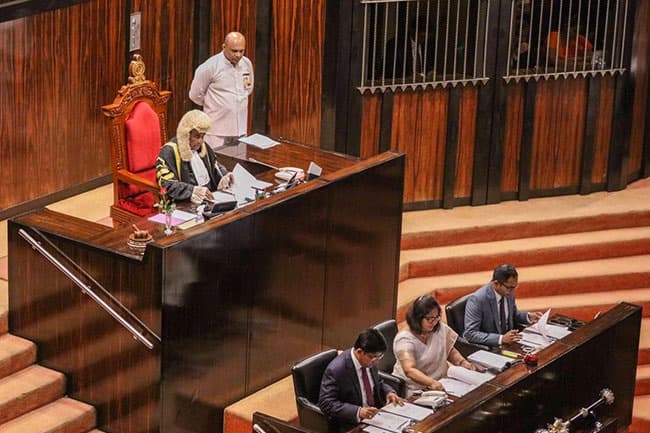


The inaugural session of the Tenth Parliament is scheduled to commence on November 21. The first day of Parliament’s inaugural session holds particular significance due to the series of special proceedings expected to take place on that day.
On the first day of the Parliament, the primary responsibilities within the Chamber are entrusted to the Secretary-General of Parliament. Members of Parliament are not assigned specific seating arrangements on this day and are allowed to sit in any seat of their choice.
Following the placement of the mace in the Chamber, the Secretary-General will present to Parliament, as the first business of the day, the Extraordinary Gazette Notification issued by the President, which specifies the date and time for the convening of Parliament.
Subsequently, in accordance with Article 64(1) of the Constitution and Standing Orders 4, 5, and 6 of Parliament, the Speaker is elected by vote, followed by the administration of the official affirmation or oath of office by the Speaker. Thereafter, Members of Parliament take their official affirmation or oath, and the Deputy Speaker and Deputy Chairperson of Committees are elected by vote.
Electing the Speaker
Any Member of Parliament may be appointed as the Speaker. However, prior to nominating a member for the position, it is essential to confirm that the Member is willing to accept the appointment.
The election of the Speaker must proceed based solely on the nominations made by Members, without allowing any debate on the matter, according to the Parliamentary Communications Department.
At this stage, the Secretary-General informs the House that the Speaker must be appointed first. When a member rises to propose a name, the Secretary-General directs the House’s attention to that Member’s nomination. After one name has been proposed, the Secretary-General must ask if there are any other nominations. If no other nominations are presented, that Member is duly elected as Speaker.
It is a long-standing tradition for the two Members who formally proposed and seconded the name of the Speaker to escort the elected Member to the Speaker’s chair, holding them by the arms. The Speaker then takes their official affirmation or oath of office before the Secretary-General. Before taking their seat, it is customary for the newly appointed Speaker to briefly thank the House for the appointment.
Congratulatory remarks are then offered by both the government and opposition representatives, after which the Speaker delivers a statement of thanks. Following this, the remaining Members proceed to take their official affirmation or oath before the Speaker.
When the names of two Members are proposed for the position of Speaker, a secret ballot is conducted. There are two instances in parliamentary procedure when a secret ballot is held: during the election of the Speaker, Deputy Speaker, Deputy Chairperson of Committees, and also when Parliament elects a President.
During the ballot, a continuous five-minute Quorum Bell shall signal Members to prepare. The Secretary-General then distributes ballot papers to each Member, who must write the name of their chosen candidate and sign the paper. Members then fold the ballot paper discreetly and place it in the ballot box.
The authority to determine the voting method and to conduct the count rests solely with the Secretary-General, who tallies the votes at the Table of Parliament. After counting, the Secretary-General announces the result to the House. If a ballot paper lacks the Member’s signature, it is deemed invalid.
If three Members are proposed for the position of Speaker and no candidate secures an absolute majority in the vote, the candidate with the least number of votes shall be eliminated, and a new round of voting is conducted. The candidate who then receives the majority of votes is elected as Speaker. Similarly, in instances where multiple Members are proposed, successive rounds of voting are held, eliminating the candidate with the least votes each time, until one candidate secures an absolute majority. At any point, if a candidate achieves an absolute majority, they are immediately elected as Speaker.
In cases where three Members stand for election and two of them receive an equal number of votes, the Secretary-General has the authority to eliminate one of the tied candidates by drawing lots. Following this, a vote is held between the remaining candidate and the candidate with the highest votes, and the Speaker is selected based on the results.
If there is a vote between two candidates and both receive an equal number of votes, a re-vote is conducted. Should there still be a tie after this second vote, the Secretary-General has the authority to select the Speaker by drawing lots. The Secretary-General has full discretion to determine the procedure for drawing lots.
Following the conclusion of a vote, the corresponding ballot papers must be kept under the custody of the Secretary-General for a period of one month. After this period, they should be destroyed in accordance with the directive from Parliament, and a report of this destruction must be submitted to Parliament.
All Members of Parliament elected must sign the Member roll after taking their oath or affirmation on the first day. The Speaker signs first, followed by the Prime Minister as a tradition, after which the other Members affix their signatures. This signed record is maintained as a highly secure document in accordance with established protocols.
When the Deputy Speaker and Deputy Chairperson of Committees are to be elected, the Speaker, having already been appointed, conducts all notifications and voting procedures. After nominations for the Deputy Speaker and Deputy Chairperson are made, the Speaker will ask the House if there are any further nominations.
If none are forthcoming, the nominated Members are elected to their respective positions. Should a vote be necessary, the procedure followed will mirror that of the election of the Speaker, with the notable difference that the voting will be conducted by the Speaker instead of the Secretary-General.
After these activities are completed, Parliament will be adjourned. Typically, the adjournment will be until the next scheduled parliamentary day, according to the Sri Lanka Parliament.
However, according to Article 33 of the Constitution, if the President addresses Parliament on that day to present government policy statement, the House will be temporarily suspended at the end of these initial proceedings. When Parliament reconvenes, the President will preside over the House and present the government policy statement.
Following the policy statement the President will then adjourn Parliament until the next scheduled day.