





This article is being updated. Please refresh the page for the latest updates…
Budget Proposals -
- The 'Clean Island' project, proposed to be implemented with the support of the Ministry of Energy, will develop the islands of Delft, Nainativu, and Analaitivu as 'model islands' for integrated development and transformation.
- The 'Clean Island' project, proposed to be implemented with the support of the Ministry of Energy, will develop the islands of Delft, Nainativu, and Analaitivu as 'model islands' for integrated development and transformation.
- The Government has provided provisions of Rs. 722 million for the rehabilitation of 1,328 places of religious worship damaged by the Ditwah disaster, comprising 758 Buddhist temples, 272 Hindu places of worship, 199 Muslim places of worship and 99 Christian places of worship. In addition, among the 1,328 destroyed places of religious worship, Rs. 40 million from the Buddha Sasana Fund for 30 Buddhist temples, and Rs. 523 million from the Central Cultural Fund for archaeological sites, including places of religious worship, are being utilized for rehabilitation, and a temple is also being rehabilitated through the Anagarika Dharmapala Trust with funds donated by the Maha Bodhi Society of India.
- Anuradhapura is a sacred area of national and international importance in which many unique historical, archaeological, religious and cultural heritages of Sri Lanka are concentrated. It represents the historical heritage of Buddhist civilization. Therefore, we expect to implement a number of development activities, including improving the facilities required by devotees, road rehabilitation and waste management, while safeguarding its archaeological and religious values for future generations.
An advisory council, co-chaired by the Acting Chief Prelate of the Atamasthana, has already been established to monitor and guide this programme. For this purpose, Rs. 1,076 million has already been allocated by the Central Cultural Fund for the year 2027.
The Urban Development Authority has prepared an estimate of Rs. 8,200 million, and it is proposed to allocate Rs. 500 million for the year 2027. - Rs. 6,200 million has been allocated for activities including ensuring border security in line with national and international policies and standards on immigration and emigration, developing the Wattala Temporary Detention Centre with facilities conforming to international standards for foreigners temporarily detained due to visa crises and complications, establishing a new office complex in Trincomalee to enhance regional operations, and digitalizing immigration and emigration activities.
- Rs. 500 million has been allocated for feasibility studies and the preparation of plans to construct a 15-storey building with the modern facilities required for investigating evolving crimes such as cybercrime and the suppression of financial fraud, for the Criminal Investigation Department, which is operating in a severely dilapidated building in Colombo Fort.
- Rs. 9,500 million has been allocated for the digitalization of the duties of the Sri Lanka Police, the complete modernization of the National Police Academy, the development of the Police Hospital in Narahenpita, the development of the Police Training School in Attidiya, the construction of the Police Sports Complex in Mirihana, and the upgrading of facilities and infrastructure at the Special Task Force camps in Gonahena, Kurunegala, Arantalawa, Kegalle and Kirindiwela.
- Rs. 900 million has been allocated to carry out a scientific study on the sustainable development of the Beira Lake and the surrounding land use and prepare a development plan, and in the meantime to implement the essential development activities already identified.
"I emphasized in the last Budget the need for a sustainable solution for urban flood control," the President said, adding that Rs. 250 million was allocated to prepare a short-term, medium-term and long-term plan for this purpose. That plan is currently being prepared, he said. - Additionally, there are plans to develop a section of the Hamilton Canal.
Furthermore, projects to improve the 'Bindunu Ela' (canal) system in Wadduwa and Molligoda (Kalutara District) as well as rainwater drainage systems in the Gampaha and Ratnapura districts, and in Dikwella, Beruwala, and Rathgama are set to commence in 2027. - Rs. 3,200 million has been allocated for projects aimed at improving urban flood control and environmental systems, including the restoration of identified canals in Colombo and its suburban cities and the improvement of the stormwater drainage system adjacent to the Piliyandala–Kesbewa by-road.
- The President said that urban flooding is caused by the failure to properly maintain the main canals in the city of Colombo and its suburbs in a timely manner, as well as the insufficient capacity of the canals that carry rainwater.
In addition to the flood mitigation projects already underway in Kolonnawa and Oliyumulla areas associated with the city of Colombo, several other key initiatives are slated to
commence in 2027, he said.
These include the 'Mudun Ela' project (aimed at flood prevention in the Wattala, Kelaniya, and Biyagama areas), a project to upgrade the stormwater drainage system in Piliyandala and Kesbewa, as well as the rehabilitation projects for the St. Sebastian Canal and the Kirulapana Canal, both designed to control flooding in the North Colombo region. - It is expected that trains will be able to operate up to Kandy within the first quarter of 2027.
- To encourage the private sector to deploy Metro Buses as well, existing route permit holders will be encouraged to add a modern low-floor bus to operation in place of their existing buses.
- Steps have already been taken to import 600 air-conditioned buses to provide a comfortable and safe service to long-distance passengers.
- It is proposed to allocate Rs. 1,000 million to purchase 50 small buses of 22 seats required for rural areas with narrow hill roads.
- It is proposed to allocate Rs. 4,000 million to obtain 200 small buses of 33 seats required for passenger services in rural areas.
- Rs. 200 million has been allocated for the Digital Transformation and Integrated Management Systems Development Project of the Sri Lanka Transport Board.
- It is proposed to allocate Rs. 600 million to establish the Department of Motor Traffic on the Werahera premises in order to provide a more efficient service.
- Rs. 700 million has been allocated to establish a modern digital system for the process of vehicle registration and transfer of ownership, with the aim of providing efficient and transparent services to the public.
- Rs. 1,500 million has been allocated to establish a new digital Driver Demerit Points System and a road safety enforcement system, integrating the Department of Motor Traffic and the Sri Lanka Police, to minimize road accidents and for road safety.
- Rs. 5,000 million has been allocated to purchase 5 new trains for the railway service.
- Provisions of Rs. 2,000 million have been allocated in 2027 for the programme to repair railway stations that have not been properly maintained for a long time.
- Train operations between Colombo and Peradeniya have been resumed by deploying the resources of the Department of Railways with maximum efficiency to restore the Up-Country railway line damaged by the Ditwah disaster.
- Activities such as the construction of the depots required for these buses, the provision of the necessary charging facilities and the provision of training will commence next year, and provisions of Rs. 4,500 million have been allocated for this purpose.
- The Government has invested in Metro Buses up to now. More than 120 buses are already in operation. A further 50 buses are scheduled to be added to that company in 2027.
In addition, the govt has also planned to introduce electric buses.
100 buses are scheduled to be received for this purpose as a donation from the Government of China, says the President. - It is expected to extend the Metro Bus service introduced around Colombo this year to the urban areas of Kandy, Galle and Jaffna as well.
- Rs. 50 million has been allocated from the Wildlife Fund for the initial work on constructing a centre for the treatment and rehabilitation of injured marine animals such as turtles and dolphins on a land area of 2 acres in the Dodanduwa area.
- With the aim of minimizing the human-elephant conflict and protecting human lives and wild elephants, the Handapanagala, Koholankala and Wetahira Kanda elephant corridors were released in June 2026, and it is expected to declare the elephant corridor located between the Nachchaduwa Wewa and Maha Kanadarawa Wewa as a wildlife reserve.
- Rs. 250 million has been allocated for the construction of new electric fences and the rehabilitation of existing electric fences. In addition, it is expected to allocate provisions of Rs. 200 million for this purpose from the Wildlife Fund as well.
- A land area of 03 acres has been identified within the Nuwaragam Forest Reserve in the Anuradhapura district to construct a hospital capable of treating wild animals for animal welfare. It is expected to allocate Rs. 700 million from the Wildlife Fund for the establishment of this hospital.
- It is expected to further strengthen the Tourist Police service to promote Sri Lanka as a safe tourist destination. It is proposed to provide a prompt and efficient security service to tourists by providing specialized training, deploying officers with multilingual capabilities, establishing special patrol units around major tourist sites, and introducing a 24-hour tourist emergency hotline service and a mobile application.
- A Cruise Tourism passenger terminal will be established in the Port of Colombo. Financing of Rs. 240 million will be provided from the funds of the Sri Lanka Tourism Development Authority (SLTDA) to modernize passenger terminal service facilities in the areas of Galle, Tangalle and Trincomalee and to expand the services provided to tourists.
- It is expected to deploy Rs. 500 million from the funds of the Sri Lanka Tourism Promotion Bureau (SLTPB) for a concessionary loan scheme for tourism service providers to obtain the necessary equipment, including boats, to promote Marine Tourism.
- Rs. 35 million has been allocated, in addition to the capital contribution of Rs. 133 million provided by the Sri Lanka Tourism Development Authority (SLTDA), to establish a centralized online e-ticketing system covering the main tourist attractions of Sri Lanka.
- With the financial assistance of the World Bank, at a cost of USD 77 million, the historic and ancient buildings located around Colombo Fort will be restored in a manner that protects their historical value and developed as a tourism zone.
- The historic Dutch forts located in the areas of Jaffna, Mannar, Kalpitiya and Batticaloa will be promoted as tourism development hubs under public-private partnerships (PPP), while ensuring the antiquarian value and conservation of the historic heritage. It is expected to deploy Rs. 240 million for this purpose from the underutilized funds of the Sri Lanka Tourism Development Authority (SLTDA).
- It is proposed to establish a centre within the Faculty of Medicine, Ragama to train doctors in Robotic Surgery. It is expected to provide training for the work of this centre in collaboration with foreign universities. It is proposed to allocate Rs. 250 million for this purpose.
- In addition to the development projects currently being implemented in hospitals providing secondary and tertiary care services, Rs. 1,245 million has been allocated to commence a number of new projects, including official quarters, at the Badulla and Batticaloa Teaching Hospitals, the Matale and Nawalapitiya District General Hospitals, and the Puttalam Base Hospital.
- It is proposed to allocate Rs. 100 million to provide spectacles free of charge to school children to minimize disruptions to education caused by visual impairments.
- Rs. 400 million has been allocated to implement widely within the country the biological Wolbachia dengue vector control method, with the technical contribution of the World Mosquito Program (WMP) and the co-financing contribution of the Government, to control the dengue epidemic.
- An organ transplant centre, including for the liver, at a cost of Rs. 3,155 million, will be established within the National Hospital of Colombo with the financial contribution of local and foreign institutions and organizations. Rs. 50 million has been allocated in 2027 for the initial activities.
- 100 new ambulances will be added in 2027 under Indian assistance of Rs. 1,725 million to expand the 1990 Suwa Seriya service, which consists of 319 ambulances.
- In order to ensure a better quality and more efficient service to the people, it is proposed to allocate Rs. 3,000 million in 2027 to add new ambulances to the system in place of the old ambulances.
In addition, 25 ambulances through Asian Development Bank loan assistance and 20 new ambulances as a grant from Japan, coordinated by the Asian Development Bank, will be added within the next year. - Provisions of Rs. 65,587 million are required to fully meet, within 03 years, the requirement for high-end biomedical equipment identified through a formal study, including MRI, CT and Cath Lab, which is necessary to enhance diagnostic and treatment services in all hospitals. For this, it is proposed to allocate Rs. 5,000 million in addition to the provisions of Rs. 15,500 million allocated for the year 2027.
- It is proposed to allocate Rs. 300 million for the construction of an Accident and Emergency Treatment Unit with modern facilities at the Thambuttegama Base Hospital.
- In response to the requests of the people of those areas and to provide an optimal service at the level of national hospitals, it is proposed to transfer to the central Government the District General Hospitals of Mannar, Mullaitivu, Vavuniya, Kilinochchi, Gampaha and Avissawella, which are administered by the Provincial Councils, out of the 20 District General Hospitals.
- Rs. 500 million has been allocated for the rehabilitation of 77 existing coastal early warning towers, the construction of 120 new land-based towers covering flood, landslide and tsunami-prone areas in 25 districts, and the establishment of a multi-hazard early warning communication system.
- Rs. 670 million has been allocated to establish an island-wide digital radio communication system.
- Rs. 670 million has been allocated to establish an island-wide digital radio communication system.
- Rs. 500 million has been allocated to provide disaster response equipment essential for strengthening early warning.
- Rs. 1,000 million has been allocated for the rehabilitation of safe centres to ensure the safety of people during disasters.
- Rs. 1,000 million has been allocated for the rehabilitation of safe centres to ensure the safety of people during disasters.
- The installation of a modern Doppler Radar System for highly accurate weather forecasting, received as a JICA grant, will commence in 2027.
- A highly concessionary housing loan scheme of up to Rs. 5 million will be implemented to meet the housing needs of migrant workers. Under this scheme, steps will be taken to provide an interest subsidy of 10 percent for up to Rs. 3 million and an interest subsidy of 5 percent for the remaining Rs. 2 million.
- The govt proposes to introduce a "Global Sri Lankan Heritage Citizen" programme for the second and third generations of the overseas community of Sri Lankan origin. Accordingly, the govt proposes to grant dual citizenship, free of any charge, to the spouse and children of an applicant for dual citizenship, as well as to third-generation children.
- It is proposed to allocate Rs. 1,000 million for a programme to be implemented by 'Clean Sri Lanka' to ensure physical accessibility within government institutions giving effect to a Supreme Court order and addressing the mobility needs of the elderly and persons with disabilities in the country.
- An empowerment pilot project was implemented with the assistance of projects funded by the Asian Development Bank and the World Bank, and Rs. 4,500 million has been allocated for the programme to systematically empower eligible families with potential.
- Rs. 25,000 million has been allocated to implement the integrated rural development programme island-wide under the Praja Shakthi National Movement, giving priority attention to the eradication of poverty.
- Rs. 25,000 million has been allocated to implement the integrated rural development programme island-wide under the Praja Shakthi National Movement, giving priority attention to the eradication of poverty.
- The monthly allowance provided to persons with disabilities will be increased by Rs. 2,500, from Rs. 10,000 to Rs. 12,500.
- The monthly allowance provided to kidney patients will be increased by Rs. 2,500, from Rs. 10,000 to Rs. 12,500.
- Rs. 230 billion has been allocated in 2027 for social protection allowances, including Aswesuma, to minimize economic hardships and ensure the social protection of the poor and extremely poor groups by continuing to provide them with Aswesuma benefits.
- Rs. 77.5 million has been allocated for the year 2027 to establish a Youth Political Leadership Academy at an estimated cost of Rs. 208 million, with the aim of training young men and women for political and community leadership and involving them in regional and national-level decision-making processes.
Further, Rs. 45 million has been allocated for research and development activities to encourage innovation in the youth sector. - As appreciation awards for gold medalists at international competitions, it is proposed to provide Rs. 100 million for an Olympic gold medal, Rs. 100 million for a World Athletics Championships gold medal, Rs. 75 million for a Commonwealth gold medal, Rs. 50 million for an Asian gold medal and Rs. 15 million for a SAARC gold medal. Correspondingly, it is also proposed to provide appreciation awards for silver and bronze medals at these competitions and for other international competitions.
- It is proposed to increase the Rs. 50 million currently allocated for construction work, including the 400-metre synthetic running track at the Anuradhapura Sports Complex, up to Rs. 1,000 million, in order to increase access to international-standard sports facilities for the North Central, Northern and Eastern Provinces.
- Rs. 2,500 million has been allocated to establish a sports culture with the aim of enhancing the sports skills of school students and the youth community and directing the elderly generation towards sports.
- Provisions of Rs. 1,500 million have been allocated for the development and modernization of the Sugathadasa National Indoor Sports Complex, the purchase of the required sports equipment and the construction of a synthetic running track at the Sugathadasa International Stadium.
- A National High-Performance Centre will be established to provide sports science methods, physical fitness training, nutrition counselling, sports medicine services and mental preparation facilities to elevate the talents of sportsmen and sportswomen to international level. Its first phase will commence at the Torrington Stadium, and Rs. 300 million has been allocated for establishing the second phase within the Diyagama Sports Complex.
- Provisions have been allocated to continue in 2027 the incentive allowance of Rs. 200 per day provided to estate workers last year.
- It is proposed to allocate Rs. 1,000 million to provide a fertilizer subsidy of Rs. 4,000 per bag, with the aim of ensuring the continued application of fertilizer in rubber plantations.
- It is proposed to allocate Rs. 5,000 million to provide a subsidy of Rs. 4,000 per bag of fertilizer obtained by small-scale tea holders, in order to ensure the continuous application of fertilizer in tea cultivation.
- Rs. 2,500 million has been allocated for the Coconut Rehabilitation Project to increase the productivity of low-productivity coconut estates.
- Rs. 730 million has been allocated to implement the programme to establish 500 tea villages covering the Southern, Sabaragamuwa, North Western, Western, Uva and Central Provinces through an integrated approach, aimed at increasing the overall productivity of the smallholder tea sector, which contributes around 70 percent of tea production.
- It is expected to increase the export earnings of USD 3 billion currently generated by the plantation sector to USD 5 billion by 2030. For this, Rs. 13,000 million has been allocated for the development of the plantation sector in 2027.
- Rs. 2,500 million has been allocated for the development of minor irrigation under the "Wari Mahimaya – Ape Urumaya" programme, and Rs. 1,500 million has also been allocated for the rehabilitation of minor irrigation schemes damaged by the Ditwah disaster.
- Rs. 19,500 million has been allocated for the Mahaweli Water Security and Investment Programme, including the North Central Province Greater Canal Project.
- Rs. 5,000 million has been allocated for irrigation projects such as the implementation of the Wayamba Canal Project to divert surplus water from the Weemedilla Reservoir to the Mee Oya basin in the Kurunegala district, the modernization of the over 50-year-old Rajanganaya lift irrigation scheme, the completion of work on the halted feeder canal from the Siyambalangamuwa Oya to the Mahagalgamuwa Oya, and the mitigation of floods in Gampaha town.
- It is proposed to allocate Rs. 1,000 million to meet the water requirements of the Batticaloa and Ampara districts, minimize flood risk and commence the Mundeni Aru River Basin Development Project.
- Rs. 7,500 million has been allocated to accelerate the work of the Lower Malwathu Oya Project, construction of which has already commenced, for the agricultural and social development of the Anuradhapura, Vavuniya and Mannar districts.
- Provisions of Rs. 3,000 million were provided in 2026 to recommence the construction of the new Milco milk processing factory at Badalgama, on which EUR 57 million had been spent but which had been suspended for a long time.
Rs. 3,000 million has been allocated for the year 2027 to complete its work and establish the Milco factory there. - Provisions have been allocated for a feasibility study to establish a special economic zone, centred on the Western and North Western Provinces, for the export of chicken and chicken-related value-added products to foreign markets.
- It is expected to develop and maintain identified farms of the National Livestock Development Board as "Breeding Farms". Rs. 1,800 million has been allocated for the importation of foundation breeding animal stocks of high genetic quality required to establish specialized Nucleus Herds of "dairy cattle and buffaloes" at the Nikaweratiya Farm, "pigs" at the Horakele Farm, and "sheep" at the Siringapatha Farm.
- It is proposed to increase the compensation paid in the event of the sudden death of a fisherman engaged in the fisheries industry due to an accident while engaged in the industry from Rs. 1 million to Rs. 2 million.
- Rs. 1,000 million has been allocated for sustainable development projects for fisheries resource management through ocean surveys, habitat mapping, fish stock assessments, the collection of monitoring data, laboratory analyses and ecosystem restoration activities.
- It is proposed to allocate Rs. 300 million for the development of the Aquaculture Development Centre in Polonthalawa, which currently carries out development activities relating to the inland fisheries industry.
- Rs. 1,500 million has been allocated for the development of the Gandara Fishery Harbour.
- Rs. 300 million has been allocated for the development of the Chilaw and Wellamankaraya fishery harbours.
- It is proposed to allocate Rs. 5,000 million for the development of the infrastructure required for the fisheries industry in the Northern Province, anchorages and the Pesalai Fishery Harbour.
- For the above proposals, the Colombo Stock Exchange will deploy Rs. 250 million, and it is proposed to allocate an additional Rs. 500 million for this purpose.
- It is proposed to introduce a mechanism to encourage the listing on the stock market of small and medium-scale enterprises (SME Listing Support Mechanism), which makes a significant contribution to the economy and job creation.
- It is proposed to implement a new programme named "A Share for Everyone" under the vision "Let's Know, Let's Learn, Let's Invest".
With the aim of actively connecting students in schools who are studying for the Advanced Level in Grade 13 and are over 18 years of age with the stock market, it is proposed to introduce the project to provide a share portfolio subject to a maximum of Rs. 10,000, in accordance with a formal selection procedure. - The necessary investments for improving the facilities, including the passenger terminal, of the China Bay Airport will be made by AASL in 2027.
- It is proposed to allocate provisions of Rs. 100 million for improving the facilities, including the passenger terminal, of the Sigiriya Domestic Airport for the promotion of tourism centred in Sigiriya.
- The Ratmalana International Airport will be developed for pilot training, and domestic, business and regional aviation. To ensure aviation safety, a project of Rs. 6,000 million to rehabilitate the existing runway and extend it from 1,400 metres to 1,771 metres will commence in 2027 with the funds of AASL.
- A re-export hub will be developed within the airport on a Build-Operate-Transfer (BOT) basis to transform the Bandaranaike International Airport into an air cargo handling hub, with the participation of the private sector as well.
- A feasibility study will be carried out for the widening of the road in front of the Bandaranaike International Airport and the construction of a flyover to minimize traffic congestion at and around the airport. It is proposed to allocate Rs. 200 million for this purpose.
- A new car park will be constructed by AASL at a cost of Rs. 400 million to minimize vehicle congestion in and around the airport.
- Construction work on the delayed second terminal of BIA is scheduled to commence very soon with the assistance of the Japan International Cooperation Agency (JICA).
- Construction of a Domestic Air Terminal within the airport premises will commence next year by Airport and Aviation Services (Sri Lanka) Limited (AASL) with an investment of Rs. 800 million, to enable international air passengers to travel more conveniently to domestic destinations.
- Work to increase the capacity of the first terminal of the Bandaranaike International Airport (BIA) from 6 million to 9 million has already commenced with an investment of Rs. 15,000 million by Airport and Aviation Services.
- It is expected to call for investment proposals (RFP) in 2027 to develop 29 of the 61 tanks owned by Trinco Petroleum Terminal (Private) Limited at the Port of Trincomalee, jointly established by the Ceylon Petroleum Corporation and Lanka IOC, under a public-private partnership.
- Repair work on 2 of the 5 selected tanks in the Trincomalee Upper Tank Farm has already been completed. The construction of a new pipeline system from the tank farm to the port has been planned. The Ceylon Petroleum Corporation expects to spend Rs. 7,375 million for this purpose.
- With the support of the Ceylon Petroleum Corporation (CPC), it is expected to increase bunkering capacity by 50,000 metric tons within the Port of Colombo under the participation of the private sector on a Build-Operate-Transfer (BOT) basis.
- Requests for Proposals (RFP) for the establishment of a Logistics Centre in the Port of Colombo through a public-private partnership will be called within the next 2 months.
- It has been planned to provide reliable and efficient services by technically strengthening the Vessel Traffic Management System of the Port of Colombo. Provisions of Rs. 575 million have already been allocated to commence this project of Rs. 3,578 million, which is implemented with the assistance of the Government of Japan.
- The feasibility study currently being carried out for the development of the Colombo North Port is expected to be completed in the first half of next year. It is expected to spend Rs. 300 million from the funds of the Ports Authority to expeditiously carry out the additional study on the Kelani River estuary, which is a decisive factor in the development of the North Port.
- It is proposed to provide concessionary loans of up to a maximum of Rs. 2 million at an annual interest rate of 3 percent to entrepreneurs for businesses operating home-based tourist accommodation, to improve such facilities and to start new home-based tourist accommodation, and it is proposed to allocate Rs. 100 million as the first phase for the payment of the necessary interest subsidies.
- It is proposed to provide a maximum loan amount of up to Rs. 500 million through banks at an annual interest rate of 5 percent to large-scale fisheries industrialists with export potential, fish product suppliers, boat manufacturers and manufacturers of other fishing gear required for the fisheries industry, to obtain the modern technology and other inputs they require. It is proposed to provide Rs. 1,000 million as interest subsidies for this purpose. Through this, it is expected to provide loans amounting to Rs. 15,000 million.
- It is expected to provide loans to entrepreneurs through the Samurdhi Bank up to a maximum of Rs. 5 million at a concessionary annual interest rate of 4 percent. In order to qualify for this loan facility, it is mandatory for such entrepreneurs to provide employment opportunities to at least five Aswesuma beneficiaries. It is proposed to allocate Rs. 200 million for interest subsidies for this purpose. Through this, it is expected to provide loans amounting to Rs. 5,000 million.
- In order to strengthen women-headed family units economically, it is proposed to implement a group loan scheme of up to Rs. 1 million at a concessionary annual interest rate of 3 per cent through the Samurdhi Bank.
- For this, it is proposed to allocate Rs. 200 million as the first phase for the payment of interest subsidies. Steps will be taken to provide the additional provisions required. Through this, it is expected to provide loans amounting to Rs. 12,500 million.
- It is proposed to implement the Pledge Loan Scheme for small- and medium-scale paddy mill owners for the purchase of paddy at the Government-guaranteed price as an interest-free loan scheme from 2027.
It is expected to provide financial facilities of Rs. 20,000 million through this programme.
In addition to the Rs. 350 million currently allocated, further allocations are proposed to bear the additional interest subsidy of this loan scheme. - In order to meet the existing demand for concessionary interest loan programmes, a further Rs. 30,000 million has been allocated, with the funding assistance of the Asian Development Bank, for granting loans for the capital and working capital requirements of Micro, Small and Medium Enterprises.
- Rs. 67,687 million has been allocated for interest subsidies and refinancing to banks. Through this, it is expected to provide Rs. 174 billion as concessionary loans to entrepreneurs through State and private banks.
- An investment of over Rs. 1,200 billion is scheduled to be made to electrify three main railway lines.
For the implementation of the first phase of this programme, for the year 2027; - Rs. 45,000 million for the electrification of the Kelani Valley railway line from Maradana to Homagama;
- Rs. 16,400 million for the electrification of the Main line from Maradana to Ragama;
- Rs. 17,700 million for the electrification of the Coastal line from Maradana to Panadura;
- Rs. 900 million for other operational expenses, including land acquisition, it is proposed to allocate Rs. 80,000 million, including the above.
- Rs. 680 million has been allocated for carrying out feasibility studies on road developments identified from time to time, including the Ratnapura Bypass, the Kahawatta Bypass, the Kiribathgoda Bypass and the Katunayake–Chilaw Expressway.
- Rs. 22,000 million has been allocated for the widening and development of selected road sections in order to minimise traffic congestion in the road network and ensure road safety.
- Rs. 600 million has been allocated for the construction of the Kokkilai Bridge, Rs. 400 million for the construction of the Kiran Bridge, Rs. 200 million for the construction of the Ponduhalchenai Bridge, Rs. 340 million for the construction of a new bridge across the Verugal River in the Punnaiyadi area, and Rs. 500 million for the construction of the Vadduvakkal Bridge in 2027.
The total estimate for these projects is Rs. 10,630 million. - It is also proposed to construct several new flyovers to minimise traffic congestion and improve transport efficiency.
Accordingly, Rs. 1,900 million has been allocated in this Budget for the construction of 2 flyovers at the Alawwa and Kurunegala–Muttettugala railway crossings, and a new flyover near the Kandy Post Office to provide access to the newly constructed Kandy Multimodal Transport Hub bypassing the Kandy–Matale railway line. - It is proposed to allocate Rs. 500 million for the development of connecting roads associated with the Kurunegala–Dambulla Expressway, and Rs. 5,000 million and Rs. 3,000 million, respectively, for the development and rehabilitation of connecting roads associated with the Pothuhera–Galagedara and KadawathaMirigama sections of the Central Expressway.
- Rs. 23,050 million has been allocated for the year 2027 with the aim of completing the Rambukkana–Galagedara section of the Central Expressway by July 2029.
- Rs. 4,500 million has been allocated for the year 2027 with the aim of completing the Pothuhera–Rambukkana section of the Central Expressway by May 2027.
- Rs. 53,450 million has been allocated for the year 2027 with the aim of completing the Kadawatha–Mirigama section of the Central Expressway by September 2028, which had been stalled.
- Rs. 18,680 million has been allocated in 2026 for the initial activities of the development of the first phase of the Ruwanpura Expressway from Kahathuduwa to Ingiriya, and it is proposed to allocate Rs. 27,000 million in 2027.
- It is proposed to allocate Rs. 30,000 million for the construction from Kurunegala to Galewela as the first step of the Kurunegala–Dambulla expressway section, which is the 4th phase of the Central Expressway.
- “Through this Budget, we expect to make the largest investment in the development of highways, expressways and railways,” the President said, adding that Rs. 251 billion has been allocated for this purpose in this Budget.
- Rs. 7,600 million, including operational expenses, has been allocated to coordinate all such research activities under the Ministry of Science and Technology.
- The National Research and Development Bill has been drafted. It is expected to be presented to this Parliament in the first half of 2027.
- Through Government investment, Rs. 23,800 million has been allocated for research and development programmes in 2027.
- It is expected to make a capital investment of Rs. 11 billion for the development of the vocational education and training sector, to modernize infrastructure, update curricula, integrate new technologies and strengthen collaboration between the public and private sectors.
- Meanwhile, the distribution of school materials will continue with financial assistance from China.
- President Dissanayake also announced plans to expand internet facilities across all schools, noting that more than 6,000 schools already have internet access.
- The Government expects to extend internet connectivity to approximately 4,000 primary schools that have yet to receive the facility.
- He said schools would also be provided with the necessary equipment, including smart boards, to support technology-based learning.
- The President further highlighted the importance of improving teachers' digital literacy to ensure they can effectively utilise modern technology in the classroom.
- In addition, Rs. 35,000 million has been allocated for the development of educational facilities and infrastructure in schools and teacher training colleges.
- The monthly allowance for instructors and trainers at teacher training colleges will be increased from Rs. 10,500 to Rs. 20,000.
The allowance for Dhamma school teachers will be increased from Rs. 7,500 to Rs. 12,500.
The daily stipend for student monks at Pirivenas will be increased to Rs. 50, and the daily allowance for lay students will be increased to Rs. 25. - Education reforms for Grades 2 and 6 will be implemented from next year.
- Dissanayake says the government will continue implementing education reforms despite opposition, with increased financial support for teacher trainees and measures to expand digital facilities across schools.
- Taxes on new communication towers are to be removed for a period of 5 years to expand high-speed broadband and internet coverage across rural areas by 2030.
- He announced plans to establish an Artificial Intelligence (AI) Excellence Centre at Wijerama Mawatha as part of the Government's efforts to strengthen national AI capabilities and promote the responsible use of artificial intelligence.
- Delivering the 2027 Budget speech in Parliament, President Dissanayake said the proposed centre would form part of the Government's broader efforts to advance digital transformation and develop the country's technological capacity.
- Dissanayake said state institutions would be required to adopt digital systems through GovTech Sri Lanka as part of efforts to modernise public services and improve institutional efficiency.
- He also emphasised the importance of strengthening data protection in the digitalisation process, noting that appropriate legal safeguards were necessary to ensure the security and responsible management of public data.
- The President said the Government expected to introduce new legislation relating to data protection and digital governance at the beginning of 2027.
- Meanwhile, he revealed that the proposed Cyber Security Bill had been forwarded to the Attorney General for consideration and approval.
- The government has called for bids for a Rs. 16.3 billion pipeline project connecting the Port of Colombo and Kolonnawa to improve fuel unloading efficiency.
- The project aims to reduce the unloading time for a 90,000-metric-tonne fuel vessel from 96 hours to 48 hours, minimising costly delays.
- According to the President, each day of delay results in approximately USD 30,000 in additional costs. The proposed project could therefore save up to USD 60,000 per shipment in demurrage charges.
- The Government also plans to increase the country's fuel storage capacity to 45 days to strengthen energy security.
- In addition, Rs. 22.34 billion has been allocated for a project to construct a jet fuel pipeline from Muthurajawela to Bandaranaike International Airport (BIA) and develop fuel storage facilities with a capacity of 92,000 metric tonnes.
- The government also plans to install a 30-megawatt battery storage system at the Norochcholai Power Plant.
- The President said that bids were called by the Petroleum Development Authority for oil and natural gas exploration and production in four offshore blocks in the Mannar Basin, with bidding closing on February 02, 2027.
He said that the relevant blocks will be awarded promptly after a review, to enhance the country's oil and natural gas production. The 10% Ports and Airports Development Levy will be removed from imported batteries required to store electricity generated from rooftop solar systems, says the President.
President Dissanayake said the tax concession would provide additional savings for households, estimating that the removal of the levy would reduce the cost of a 1kW battery by approximately Rs. 4,000.
He said that a total of 300,000 smart meters will be provided free of charge to electricity consumers whose monthly electricity consumption exceeds 180 units, with USD 12 million in funding from the Asian Development Bank (ADB).
All Lanka Electricity Company (LECO) consumers using more than 120 units will also receive smart meters under the programme.
Domestic consumers establishing rooftop solar panel systems will be provided with a subsidy when purchasing batteries necessary for storing generated electricity.
He said domestic consumers installing rooftop solar power systems with battery storage will receive a subsidy of Rs. 25,000 per kilowatt of battery storage capacity under the Net Plus methodology, up to a maximum of 10 kilowatts or Rs. 250,000.Rs. 3,500 million will be allocated for this purpose.
- Rs. 26.5 billion will be allocated to strengthen the electricity transmission network and ensure a stable electricity supply in the country, says the President.
- President Dissanayake says that the government will pursue the expansion of the India-Sri Lanka Free Trade Agreement.
- He added that the government will explore the possibility of establishing a new Free Trade Agreement (FTA) with China and will seek to enter into expanded economic partnership agreements with the United Arab Emirates (UAE) and Oman.
- The Investor Protection Bill will soon be presented to Parliament, says the President, adding that the Colombo Port City Economic Commission Act will be amended to attract foreign investment.
- “A stronger new legal framework is necessary to achieve the expected economic transformation and to increase efficiency. Some of our laws are over 100 years old,” the President declared.
- The Government has appointed a committee to assess Sri Lanka's future engagement with the International Monetary Fund (IMF) following the conclusion of the current Extended Fund Facility (EFF) programme in March 2027, says the President.
- The President said the Government was committed to successfully completing the existing IMF programme while continuing to strengthen the country's foreign exchange reserves.
- He said the Government would assess whether a new arrangement with the IMF would be necessary after March 2027 and, if so, determine the most suitable type of agreement for the country. A committee has already been appointed to evaluate the available options.
- The President also announced that public debt is projected to decline to 87 per cent of Gross Domestic Product (GDP) by 2032, exceeding the Government's initial target under the IMF programme.
- He explained that the Government had initially set a target of reducing public debt to 95 per cent of GDP by 2032 under the IMF programme. However, according to the IMF's Sixth Review, if current economic trends continue, the debt burden could decline further to 87 per cent of GDP by 2032.
- The President said that the Budget deficit will be kept under 5% and that the primary surplus of the GDP will be maintained at 2.3%.
- Dissanayake says the Government has the liquidity and financial capacity to meet its foreign debt servicing obligations over the next two years. He said the Government would have to service a lower amount of foreign debt over the next two years compared to the amounts paid in 2025 and 2026.
- Speaking on debt servicing, President Dissanayake said that USD 3,707 million was spent in 2025 by the government to repay debt, USD 3,591 million in debt was cleared in 2026 and that in 2027 and 2028 this amount will be USD 2,986 million and 3,574 million, respectively.
- President AKD said that the Middle East crisis had severely affected Sri Lanka’s energy supply and that the government had spent Rs. 147 billion on relief subsidies as a result of this.
- The President said that the Budget deficit will be kept under 5%.
- President says Sri Lanka has recorded improvements in its international standing across several key sectors, with progress reflected in a range of global rankings and assessments.
- He said these improvements had been achieved despite the numerous economic and other challenges faced by the country.
- He highlighted the improvement in Sri Lanka's sovereign credit ratings by Fitch Ratings, as well as the country's progress in Transparency International's corruption-related rankings.
- The President also pointed to improvements in Sri Lanka's position in the Global Peace Index, describing the developments as evidence of progress across several areas.
- He further noted that Sri Lanka was among the fastest-improving economies in terms of economic development and had gained recognition as one of the world's leading travel destinations.
- President Dissanayake also highlighted Sri Lanka's improved economic standing, noting its position as an upper-middle-income economy.
- He said these developments reflected the progress achieved by the country despite the challenges encountered during the Government's efforts to stabilise and transform the economy.
- President Anura Kumara Dissanayake says SriLankan Airlines continues to impose a significant financial burden on the Treasury, with billions of rupees in public funds required to sustain its operations.
- Delivering the 2027 Budget speech in Parliament, the President said a special committee had been appointed to examine the airline's substantial financial losses and identify possible solutions.
- He said the committee's report would be presented to Parliament, adding that the Government needed to reconsider the future of SriLankan Airlines in view of its continuing financial burden on public finances.
- The President also highlighted the Government's efforts to increase state revenue while reducing expenditure, particularly interest payments.
- He said increased revenue from taxation and foreign remittances had contributed significantly to strengthening government finances and achieving a primary surplus.
- Commencing his Budget Speech, President Dissanayake said that the 2027 Budget was not prepared based on the ideas of one single person or a certain group, but with the ideas, opinions, proposals and experiences of various sectors and sections, as it is a collective effort.
- He said that the government gave proper attention to every proposal presented to it with regard to the Budget proposal.
- He further said that this Budget is designed to strengthen the country’s production economy.
- President Anura Kumara Dissanayake says the government's objective is to manage the country's current economic challenges while laying the foundation for a better future for the next generation.
- Delivering the 2027 Budget speech in Parliament, the President said the country had moved from a phase of economic stabilisation towards the next stage of economic transformation.
- He noted that the government had succeeded in stabilising the economy over the past two years despite having to navigate numerous domestic and international challenges.
- President Dissanayake stressed that the Budget proposals were interconnected and designed as part of a collective national programme aimed at the betterment of the country. He said due consideration had been given to all proposals in formulating the Budget.
- Referring to external economic pressures, the President highlighted the impact of rising global oil prices amid the ongoing conflict in the Middle East. He said the Government had provided concessions amounting to Rs. 147 billion to mitigate the impact of rising fuel prices on the public.
- He also revealed that the country had incurred an estimated USD 3.4 billion in expenditure in connection with the damage caused by Cyclone Ditwah and subsequent reconstruction efforts.
- The President further pointed to the challenges posed by the anticipated El Niño impact.
- Addressing public sector reform, President Dissanayake said the country did not require an oversized state machinery but rather an efficient public service that responds to the needs of the people.
- He recalled that the public had given the Government an overwhelming mandate two years ago, expressing their expectation of building a better nation.
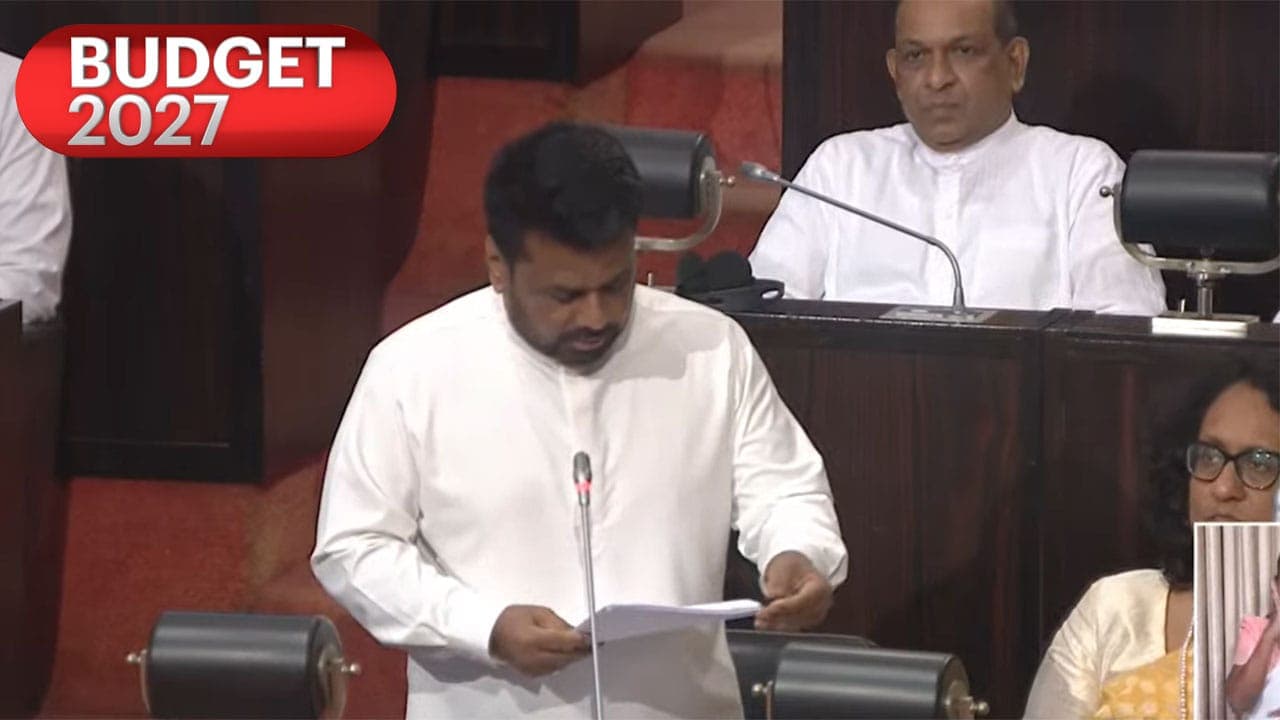
President Anura Kumara Dissanayake in his capacity as the Minister of Finance, Planning and Economic Development has commenced delivering the 2027 Budget speech in Parliament, a short while ago.
Earlier today (12), the Cabinet of Ministers approved the 2027 Budget proposals to be presented to the House by the President.
This will mark the third Budget of the National People’s Power (NPP) government and the country’s 81st Budget Speech.
The Appropriation Bill for 2027 was presented to Parliament for its first reading on October 7 by Deputy Minister of Finance and Planning, Dr. Anil Jayantha Fernando.
Following the presentation of the Budget, the Second Reading debate is scheduled to be held over seven days, from November 13 to November 20. The vote on the Second Reading is scheduled for 6.00 p.m. on November 20.
Subsequently, the Committee Stage debate on the Budget will take place over 19 days, from November 21 to December 14.
The vote on the Third Reading of the Budget is scheduled to be held at 6.00 p.m. on December 14.
President Anura Kumara Dissanayake’s Budget Speech is currently being broadcast live on TV Derana, Ada Derana 24 and Ada Derana’s social media platforms.