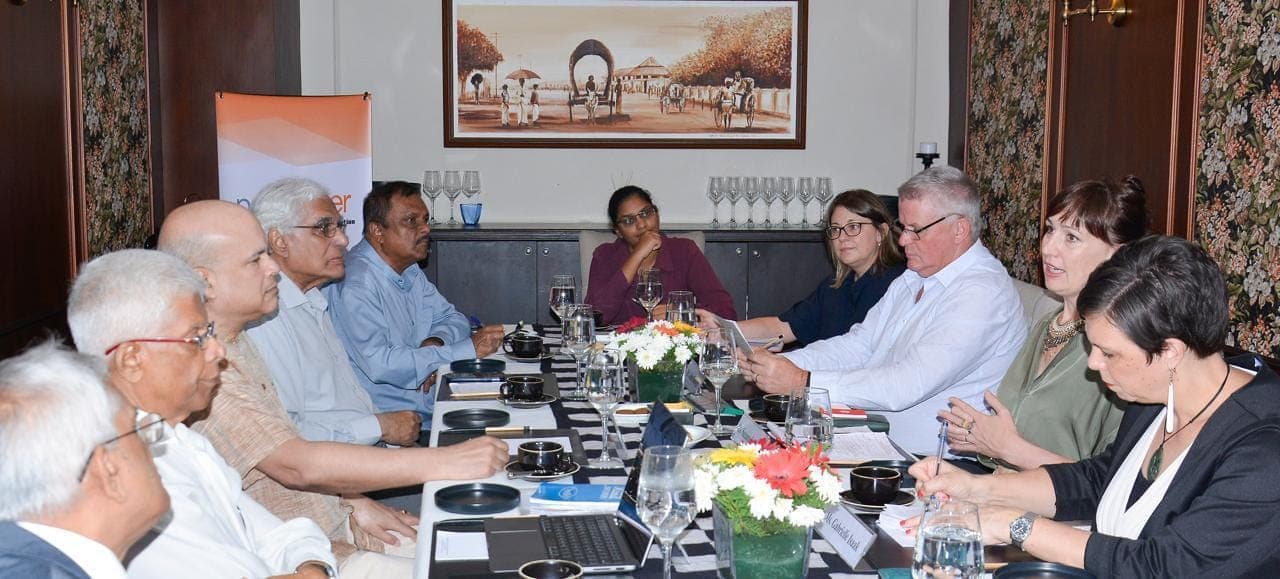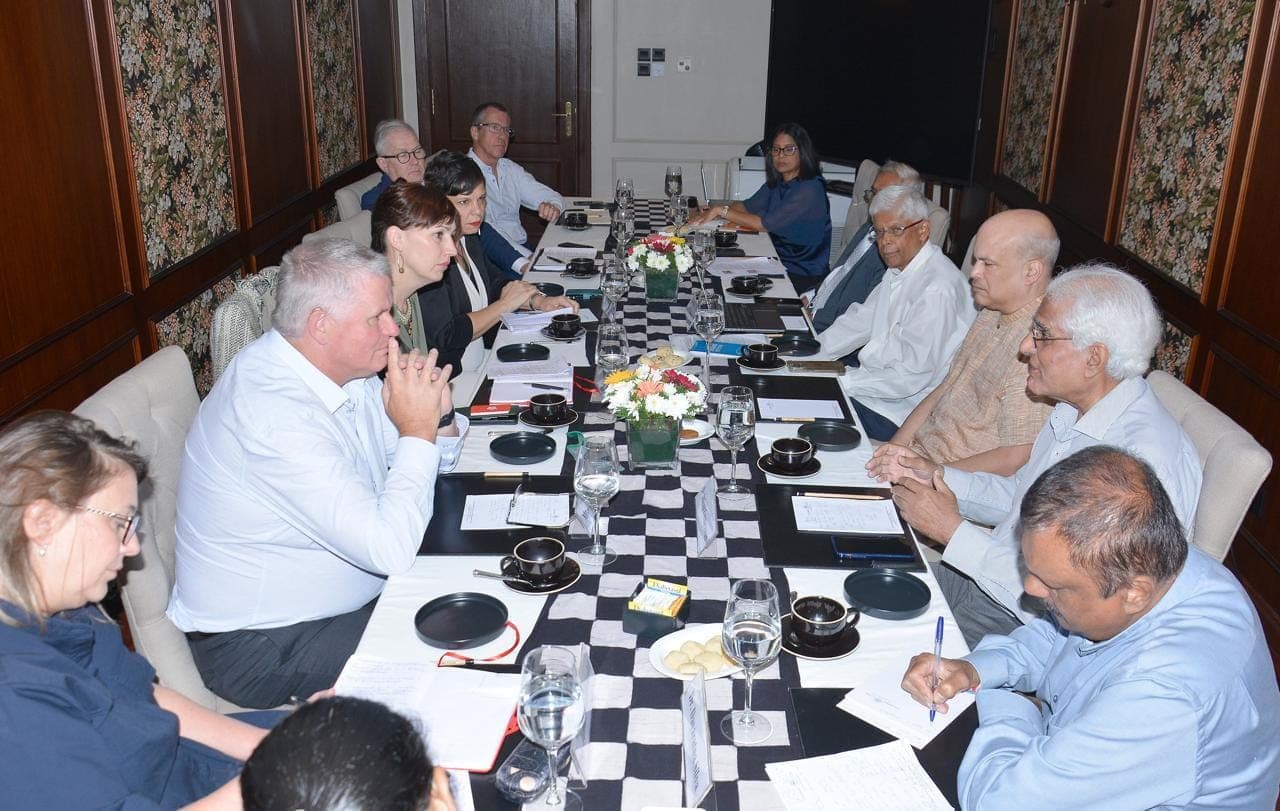









The Pathfinder Foundation hosted a delegation from the Asia-New Zealand Foundation (ANZF) in Colombo for an exchange of views on regional developments, strategic challenges and opportunities for closer cooperation between Sri Lanka and New Zealand.
Milinda Moragoda, Founder of the Pathfinder Foundation, and Gabrielle Isak, Chargé d’Affaires of the New Zealand High Commission in Colombo, presided over the meeting, which was chaired by Amb. (Retd.) Bernard Goonetilleke, Chairman of the Pathfinder Foundation, and Suzannah Jessep, Chief Executive of the Asia New Zealand Foundation, who led the New Zealand delegation.
The meeting offered both institutions an opportunity to reflect on the increasingly complex geopolitical environment and its implications for small and middle powers, particularly island nations that depend heavily on international trade, maritime connectivity and stable regional relations.
Welcoming the delegation, Amb. Goonetilleke outlined the Pathfinder Foundation’s principal areas of engagement, including Indian Ocean security, trilateral dialogues, national security strategy, and trade and economic development.
He highlighted the Foundation’s engagement with the Asia-New Zealand Foundation, which began with an inaugural dialogue in May 2024 and continued with a leadership delegation visit in November 2025.
He expressed the hope that the two institutions could further strengthen their engagement through more regular exchanges and collaborative initiatives.
Jessep emphasised the importance of the relationship between Sri Lanka and New Zealand, two island nations facing similar pressures despite their geographical and economic differences.
She observed that the regional environment was becoming increasingly uncertain, heightening strategic unpredictability. She also highlighted the efforts of small and middle powers to strengthen their resilience, build closer networks across Asia, and preserve their ability to navigate an increasingly uncertain international environment. The exchange of perspectives between countries with different experiences and strategic outlooks, she noted, was particularly valuable for understanding regional developments and preparing for future challenges.
A key theme of the discussion was the importance of maritime security, trade connectivity and supply-chain resilience.
Participants from the visiting delegation observed that international competition was increasingly extending beyond traditional security concerns to include ports, shipping networks, strategic infrastructure and control of supply chains.
Moragoda proposed that Sri Lanka and New Zealand, together with other strategically located island and smaller maritime states, could explore a platform for dialogue on the emerging challenges of maritime strategic economics. Such an initiative could provide an opportunity for smaller nations to exchange perspectives on developments affecting ports, shipping and the resilience of international trade, without necessarily forming a formal bloc, he observed.
The discussion also focused on Sri Lanka’s position in the evolving regional strategic environment, particularly its relations with India, China and the United States.
Participants exchanged views on the importance of maintaining strategic autonomy while managing relations with major powers and safeguarding national interests.
The role of regional mechanisms, including the Colombo Security Conclave and the Indian Ocean Rim Association, was also discussed.
Participants recognised the value of regional cooperation in addressing shared maritime and security concerns, while acknowledging the challenges of achieving consensus within larger multilateral groupings.
The potential for Track 1.5 and Track 2 dialogue to complement official regional processes was highlighted.
Economic resilience and Sri Lanka’s recovery were another key focus. Discussions addressed the need to strengthen investment, expand exports, improve energy security and build greater resilience to external shocks. Participants emphasised the need to move beyond macroeconomic stabilisation towards sustained growth, supported by investment, trade integration and structural reforms.
The potential for greater regional economic integration through RCEP was also explored, including opportunities arising from trade agreements and closer engagement with regional supply chains.
The discussion emphasised the need to identify practical avenues through which Sri Lanka could enhance its economic connectivity with India and the wider Asian region.
The meeting concluded with a shared recognition of the value of ongoing engagement between the Pathfinder Foundation and the Asia-New Zealand Foundation.
Both sides expressed interest in exploring opportunities for further dialogue and cooperation, including virtual discussions on specific regional and maritime issues and in identifying areas where the experience and expertise of the two institutions could contribute to a better understanding of the evolving Indo-Pacific landscape.
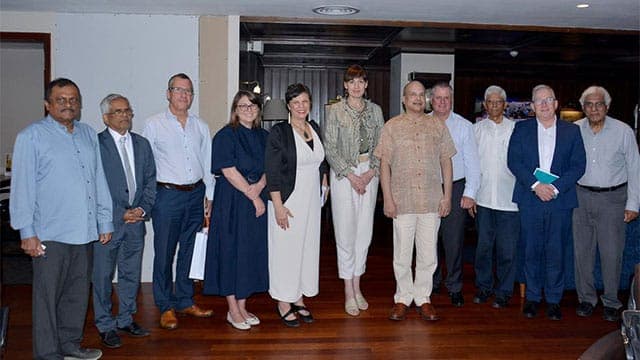
The New Zealand delegation comprised Suzannah Jessep, Chief Executive of ANZF; Prof. David Capie, ANZF Trustee and Director of the Centre for Strategic Studies at Victoria University of Wellington; John Boswell, ANZF Trustee, Chief Executive of Marlborough District Council, and former Chief of Army; Volker Kuntzsch, Chief Executive Officer of the Cawthron Institute; and Dr. Julia Macdonald, Director of Research and Engagement at ANZF.
Representing the Pathfinder Foundation were Milinda Moragoda; Amb. (Retd.) Bernard Goonetilleke; Dr. Dayaratna Silva; Dr. Indrajit Coomaraswamy; Dr. R.H.S. Samaratunga; and Manager Program PF Gayathri de Zoysa.