







Canada’s accusation that India may have been involved in the assassination of a Sikh activist on its soil has triggered a growing row with Ottawa and New Delhi both expelling senior diplomats, sending relations between the two countries plunging.
The tit-for-tat diplomatic expulsions came after Prime Minister Justin Trudeau said Canada was investigating “credible allegations” linking India to the June killing of Canadian citizen and prominent Sikh leader, Hardeep Singh Nijjar.
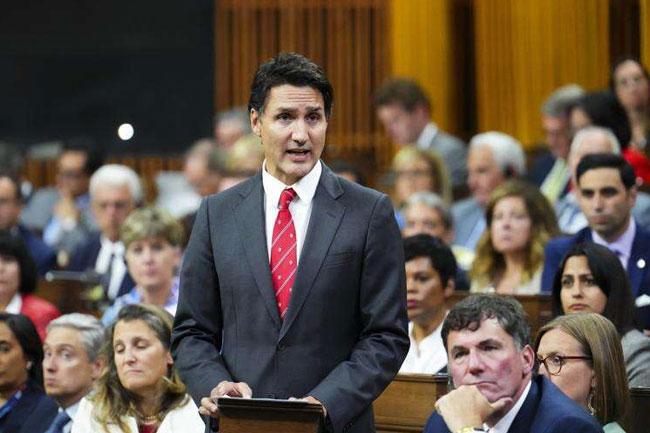
“Over the past number of weeks, Canadian security agencies have been actively pursuing credible allegations of a potential link between agents of the government of India and the killing of a Canadian citizen Hardeep Singh Nijjar,” Trudeau said in parliament on Monday, adding his government would take all steps necessary “to hold perpetrators of this murder to account.”
Canada said it had kicked out an Indian diplomat, who foreign affairs minister Mélanie Joly described as the head of the Indian intelligence agency in the country.
“Today we’re acting by expelling a key diplomat, but we will get to the bottom of this,” she told reporters in Ottawa, adding Trudeau has raised this issue with both US President Joe Biden and British Prime Minister Rishi Sunak.
India’s foreign ministry on Tuesday responded in kind, saying it had expelled a senior Canadian diplomat based in India.
“The concerned diplomat has been asked to leave India within the next five days,” it said in a statement. “The decision reflects Government of India’s growing concern at the interference of Canadian diplomats in our internal matters and their involvement in anti-India activities.”
Nijjar was a prominent Sikh leader in western Canada, and according to local police, he was gunned down in his truck in June by two masked gunmen outside a Sikh temple in Surrey, British Columbia.
His death both shocked and outraged the Sikh community in Canada, one of the largest outside of India and home to more than 770,000 members of the religious minority.
Nijjar was an outspoken supporter of the creation of a separate Sikh homeland known as Khalistan, according to a statement from the World Sikh Organization, and often led peaceful protests against what the advocacy group called the “violation of human rights actively taking place in India and in support of Khalistan.”
The Khalistan movement is outlawed in India and considered a national security threat by the government – a number of groups associated with the movement are listed as “terrorist organizations” under India’s Unlawful Activities (Prevention) Act (UAPA).
Nijjar’s name appeared on the Home Ministry’s list of UAPA terrorists.
In 2020, the Indian National Investigation Agency accused him of “trying to radicalize Sikh community across the world in favor of creation of ‘Khalistan,’” adding that he had been “trying to incite Sikhs to vote for secession, agitate against the Government of India and carry out violent activities.”
India on Tuesday said it rejected Trudeau’s allegations, calling them “absurd and motivated.”
“We are a democratic polity with a strong commitment to rule of law,” a statement released by the country’s foreign ministry said.
“Such unsubstantiated allegations seek to shift the focus from Khalistani terrorists and extremists, who have been provided shelter in Canada and continue to threaten India’s sovereignty and territorial integrity. The inaction of the Canadian Government on this matter has been a long-standing and continuing concern.”
The White House said it is “deeply concerned about the allegations referenced by Prime Minister Trudeau,” according to Reuters.
“We remain in regular contact with our Canadian partners. It is critical that Canada’s investigation proceed and the perpetrators be brought to justice,” it said.
Canadian police have not arrested anyone in connection with Nijjar’s murder. But in an August update, police released a statement saying they were investigating three suspects and issued a description of a possible getaway vehicle, asking for the public’s help.
A spokesperson for Australian foreign minister Penny Wong said the country is also “deeply concerned” by the allegations.
“We are closely engaged with partners on developments. We have conveyed our concerns at senior levels to India,” a statement shared with CNN said.
“We understand these reports will be particularly concerning to some Australian communities. The Indian diaspora are valued and important contributors to our vibrant and resilient multicultural society, where all Australians can peacefully and safely express their views.”
Souring relations
Canada’s allegations against the Indian government, led by Prime Minister Narendra Modi, are likely to further sour relations between the two countries.
An ongoing trade deal between them has been paused, India’s commerce and trade minister said, according to local reports, adding there are “certain issues which are of serious concern.”
The issue of activism within Canada’s large Sikh diaspora has long been one of the sources of tension.
When Modi hosted the Group of 20 (G20) leaders in New Delhi earlier this month, he did not hold a one-on-one meeting with Trudeau, instead meeting on the sidelines of the summit, where the Indian leader “conveyed our strong concerns about continuing anti-India activities of extremist elements in Canada,” according to a statement from the Indian government.
Relations between the two leaders have been frosty for several years.
When Trudeau visited India in 2018, his calendar, which was relatively light on diplomatic meetings, was seen by many as a “snub” from New Delhi.
Analysts at the time pointed to Trudeau’s perceived sympathy for Sikh activists as a particular area of contention.
In 2017, the Canadian leader had been seen at a Sikh event in Toronto where separatist flags and posters depicting an extremist Sikh leader killed in a 1984 Indian Army operation were displayed.
In its statement about Trudeau’s allegations on Tuesday, the Indian government said: “That Canadian political figures have openly expressed sympathy for such elements remains a matter of deep concern.”
“The space given in Canada to a range of illegal activities including murders, human trafficking and organised crime is not new,” the statement said. “We urge the Government of Canada to take prompt and effective legal action against all anti-India elements operating from their soil.”
Support for Khalistan overseas
The Sikh religion was founded in Punjab in the 15th Century by Guru Nanak and has about 25 million followers worldwide. They are a minority in India, comprising less than 2% of the country’s 1.4 billion people, but form a majority in the northern state of Punjab, which was once home to a large and powerful Sikh empire.
The origins of the modern Khalistan movement trace back to around the time of India’s independence from Britain in 1947, when some Sikhs demanded that a nation be carved in the state of Punjab for followers of the faith.
When the Partition hastily divided the former colony along religious lines – sending Muslims to the newly formed nation of Pakistan, and Hindus and Sikhs to newly independent India – Punjab, which was sliced in half, saw some of the worst violence.
Around this time, Sikhs began a greater struggle for political and cultural autonomy, scholars have said, and the Khalistan movement gained prominence.
Over the years, violent clashes have erupted between followers of the movement and the Indian government, claiming many lives.
It came to a head in 1984 when then-Prime Minister Indira Gandhi ordered Indian troops to storm Amritsar’s Golden Temple – Sikhism’s holiest shrine – to kill Sikh separatists. That operation caused huge anger within the Sikh community and Gandhi was assassinated by her Sikh bodyguards in the aftermath.
Deadly violence erupted in the days following her death, killing more than 3,000 people – mostly Sikh.
A year later the violence spilled over to Canada, when Sikh separatists bombed an Air India plane that had taken off from Toronto airport, killing all 329 people aboard, including numerous Canadians of Indian descent.
While Khalistan supporters within India remain on the margins, the movement continues to evoke a level of sympathy from some Sikhs within the global diaspora, particularly in Canada, Britain and Australia.
A small but influential number of those Sikhs support the idea of Khalistan, with referendums periodically held to reach a consensus to establish a separate homeland.
Source: CNN
--Agencies