








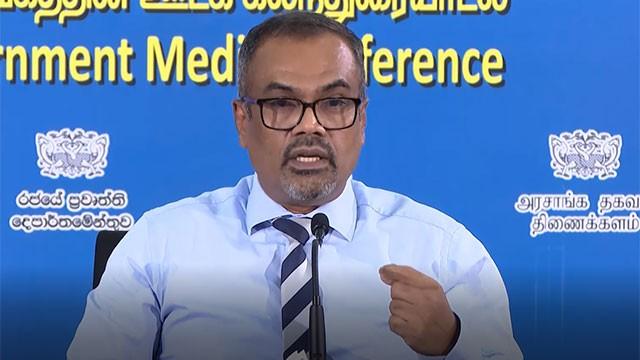



Deputy Minister of Finance and Planning Dr. Anil Jayantha Fernando said the government remains highly positive and optimistic that Sri Lanka will continue its current economic trajectory as planned.
Speaking at a press briefing held today (17), he said the first-quarter economic growth rate of 5.1% indicates that the country is moving along the expected path towards achieving the medium-term target of inclusive and sustainable economic growth of 7%.
However, he clarified that this does not mean Sri Lanka is expected to achieve 7% economic growth in 2026, as it is a medium-term target. He said gradual growth improvements, such as 5.1% and 5.5%, would contribute towards maintaining the planned economic trajectory.
The deputy minister added that the government is engaged in continuous discussions with relevant stakeholders, ministries, donor agencies, development agencies, and other parties involved in the economy.
“We are having continuous discussions. Sometimes the information may not be communicated well to society. Every day, we are having these discussions,” he said.
Dr. Anil Jayantha Fernando said achieving this target is essential to addressing the long-standing issue of poverty in Sri Lanka, developing the economy, reducing income inequality, and improving living standards for everyone.
Commenting on the fuel subsidy, the Deputy Minister said the government introduced a specific Rs. 100 billion relief package to address the impact of the external situation on the economy.
He said the government’s initial plan was to provide subsidies, concessions, and relief measures for a period of three months, as it had assessed that the impact of the external situation would remain during that period.
He explained that making a decision to continue such measures for one or two years based on an uncertain external factor would not be a prudent decision.
“The external factor has to be considered for a short-term decision. This is an explicit situation. That is the right decision,” he said.
Dr. Fernando said the government does not need to rush into a decision regarding the period after the three-month relief programme and that the situation will be reviewed based on future developments.
He assured that the government is ready to utilize available funds if required and has an adequate cash buffer while maintaining financial discipline.
He further said current developments in the global situation are positive, noting that oil prices, which had increased by 50% to 60%, have declined closer to previous levels.
He said crude oil prices, which had risen to around USD 125, have now declined closer to USD 80, while diesel prices, which had increased to around Rs. 280, have also reduced.
However, he noted that the impact of these changes would take some time to reflect and said the government hopes to manage the situation.
“If required, we will provide targeted relief based on the given situation,” the deputy minister said.