



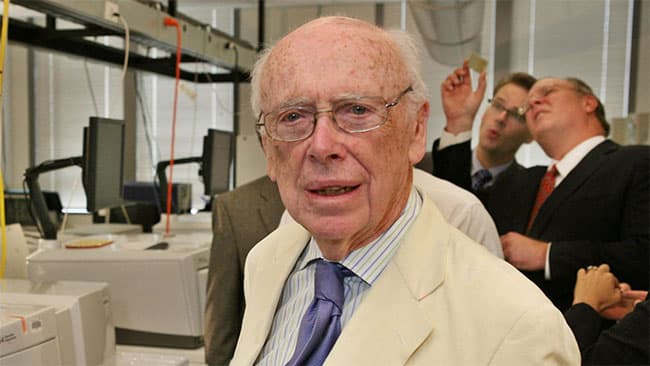



James Watson, a renowned molecular biologist and one of the Nobel Prize winners for discovering the structure of DNA, died Thursday after a brief illness, according to a statement from his former employer.
He was 97.
His death was confirmed by a spokesperson with Cold Spring Harbor Laboratory, where he spent the bulk of his career, who cited he died following a brief illness.
Watson, whose mission it was to figure out what the molecule of life looks like, won a Nobel Prize for it in 1962. He later became the first director of the groundbreaking Human Genome Project and the first living recipient to sell a Nobel Prize, some of which went toward raising money for scientific research.
“I think early on, I wanted to do something important with my life. I still want to think about science and really nothing else,” Watson told CNN in 2013. “Being driven by the desire to find the truth, that’s really my legacy. The truth, sometimes you don’t find it and it’s complicated, but what you always have is that if you can start with the truth, it’s helpful.”
His legacy was marred in later years after he made headlines for incendiary racist, sexist and homophobic remarks belittling various groups of people, claiming they had genetic differences. The remarks led to him losing some of his honorary titles.
Watson, alongside Francis Crick and Maurice Wilkins, is most known for discovering DNA’s double helix structure in 1953.
“When I was 25, my colleague Francis Crick and I published a very short paper outlining the structure of DNA,” he told CNN in 2013. “We thought it was a bombshell and fortunately, it was.”
That groundbreaking discovery, published in the journal Nature, was a huge advancement in science that gave way to the field of molecular biology. They cracked the code of how DNA stores information and how its special structure allows the molecule to replicate itself.
His curiosity started at a young age
Watson was born on April 6, 1928, in Chicago. His signature curiosity was evident as a child.
When he was 8, he wondered what makes birds migrate. The question seemed like a puzzle that he wanted to solve, inspiring him to go into science so he could understand how the natural world worked.
After only two years in high school, Watson got a tuition scholarship at The University of Chicago, just a few miles up the road. In 1947, he graduated with a degree in zoology.
He kept learning more about the field, earning a PhD in zoology at Indiana University Bloomington. It was there where his childhood interest in birdwatching gave way to his passion for learning about genetics.
Watson became mesmerized with the three-dimensional structures of molecules from his bacterial virus research at the university. He found out about the work scientists were doing at the Cavendish Laboratory in Cambridge, England, and a few years later, he joined them to work there in 1951.
He met VIP scientists and a discovery was born
Watson met two important people in 1951: Wilkins and Crick, the men with whom he would later share the 1962 Nobel Prize in Physiology or Medicine. Wilkins showed Watson photographs of the X-ray diffraction pattern of DNA’s structure and later that year, Watson learned both he and Crick wanted to discover DNA’s structure.
“At that time, we knew that a new world had been opened and that an old world, which seemed rather mystical, was gone,” Watson said of the discovery during his Nobel banquet speech in 1962.
“All we could say when we got it: It’s so beautiful!” Watson recalled of getting the structure right, which took more than a year.
Watson and Crick also used British chemist Rosalind Franklin’s work to help them with their discovery, but her contribution was largely overlooked until after her death. Watson’s first memoir, “The Double Helix: A Personal Account of the Discovery of the Structure of DNA,” stoked controversy over his account of the DNA discovery and the roles of those involved.
Franklin’s work went uncredited, and she died of ovarian cancer in 1958 before the Nobel Prize was awarded for the DNA structure discovery. While the award is never given posthumously and Franklin was never nominated, some in the scientific community say she was snubbed.
Three years after winning the Nobel Prize, Watson published the textbook “Molecular Biology of the Gene,” which is one of the most-used modern biology texts.
“I probably spent more of my career as a writer than as a scientist,” Watson said in a 2012 interview with NobelPrize.org. He said his popular textbook doubled his income and opened new worlds.
In 1968, Watson started directing the Cold Spring Harbor Laboratory, a Long Island, New York, research institution, for 25 years, transforming it into a hub for molecular biology research. It was a big year, as Watson married Elizabeth Lewis and they later had two boys, Rufus and Duncan.
Later in his career, Watson was the first director of the Human Genome Project, an international research effort that had the goal of mapping out the human genome, until 1992 when he resigned. In 2007, Watson became the second person to have his genome sequenced in its entirety and he published it online.
He turned heads for different reasons later
Watson also made news when he sold his Nobel Prize in 2014 for $4.76 million at auction, including the buyer’s premium, and the manuscript of his awards acceptance speech for another $356,000, which raised money for scientific research. A Russian billionaire bought the medal and later returned it to Watson.
Watson stirred controversy late in life, tarnishing his reputation as a scientist in a series of racist remarks. In 2007, he made comments about the intelligence of Black people in Britain’s Sunday Times. He was stripped of his title as chancellor at Cold Spring Harbor Laboratory, where he had worked for more than four decades.
He also made other controversial comments without scientific backing throughout the years. This included repeating racist comments in 2019, insinuating a claim that Blacks are less intelligent than Whites due to genetics. Those comments cost him the rest of his honorary titles at Cold Spring Harbor Laboratory.
Source: CNN
--Agencies