





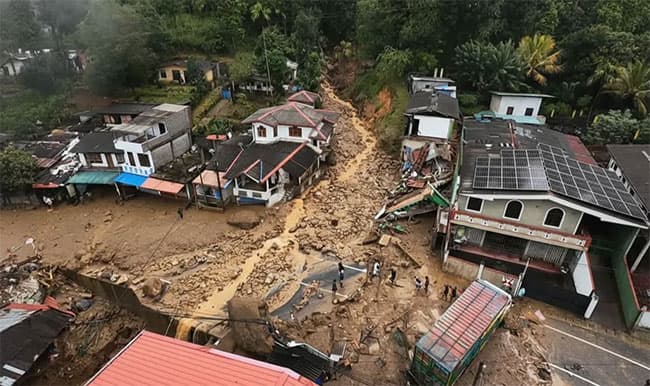



The Minister of Labour and Deputy Minister of Finance and Planning, Dr. Anil Jayantha Fernando, has explained a comprehensive set of loan relief measures aimed at supporting individuals and businesses affected by the recent disaster situation across the country.
Issuing a statement to the media, the Deputy Minister said that borrowers impacted by the disaster who have already obtained loans, either as individuals or business entities, have been requested to be granted a grace period of three to six months for the repayment of capital and interest, or both at once.
During this suspension period, financial institutions have been instructed not to charge interest above the applicable contract interest rate and to ensure that no additional interest is imposed on deferred interest payments.
He further explained that provisions have also been made to facilitate access to new loan facilities for those affected.
He said that, “There is a possibility of applying for this. There are several sectors in requesting loans for individuals and businesses. One is that the loan repayments are to be made after a minimum grace period of 3 months beyond the expiry of the suspension period. For example, a grace period of 6 months is given for existing loans. If a new loan is taken out, another 3 months are given to repay that loan.
“When charging interest on the new loan, the person or institution should be charged considering any new loan granted up to a period of 2 years, to be charged at a maximum fixed interest rate of 9% p.a. or the contract interest rate applicable to the respective borrower for overdrafts or loan facilities, whichever is lower.
“Moreover, for any new loan granted for a longer tenor beyond 2 years, the interest rate may be revised by the licensed bank to a rate linked to Average Weighted Prime Lending Rate (AWPR) at the end of 2 years as specified in the loan facility agreement with the borrower,” he stated
Addressing issues related to business transactions, the Deputy Minister noted that when conducting business, cheques are issued, which can return and several charges have been suspended for affected borrowers until January 31, 2026.
These include fees for cheque returns, stop payments, late payments, credit restructuring or modification, and penal interest on all credit facilities.
He acknowledged that some of these charges may be automatically generated by banking systems, but assured that any such charges imposed during the suspension period should be refunded to the relevant account within three business days of being charged.
Dr. Anil Jayantha also emphasized that adverse records at the Credit Information Bureau (CRIB) should not be the sole basis for rejecting loan applications from disaster-affected borrowers.
Instead, he said that loan approvals should be considered on a case-by-case basis. Any issues encountered in this regard can be reported to the relevant investigative units of the Central Bank of Sri Lanka.