





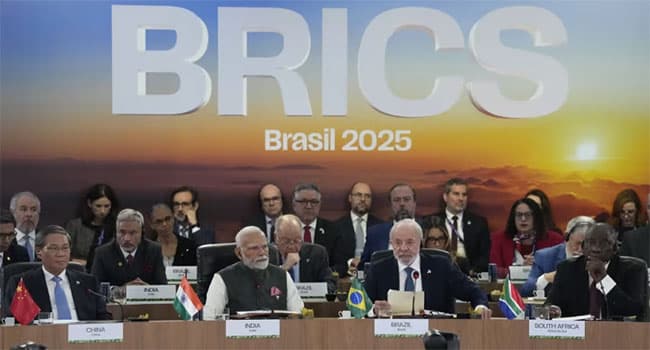


India is set to assume the chair of BRICS next year, taking the helm of an expanded bloc at a sensitive geopolitical juncture – one marked by competing interests, rising global ambitions and pressure from Washington.
India aims to underscore that its presidency will prioritise the Global South, while staying attuned to shifting developments around the world.
It will also focus on concrete outcomes for emerging economies, seeking to show that BRICS can bring together members facing common challenges even as their national interests diverge.
The task comes as the intergovernmental grouping grapples with growing prominence and scrutiny.
CHALLENGING WESTERN DOMINANCE
Originally formed by Brazil, Russia, India and China, with South Africa joining soon after, BRICS has long been viewed as an emerging diplomatic counterweight to traditional Western powers.
In recent years, it has expanded to include countries such as Egypt, Ethiopia, Iran, the United Arab Emirates and Indonesia.
Together, the bloc represents about half of the world’s population and nearly 40 per cent of global economic output.
In July, Indian Prime Minister Narendra Modi proposed reimagining BRICS as an acronym for Building Resilience and Innovation for Cooperation and Sustainability.
Analysts say high on India’s agenda could be the development of a proposed investment guarantee mechanism to tackle climate change, poverty, energy transition and infrastructure needs.
The initiative aims to create a financial structure controlled by BRICS nations rather than Western powers, operating through the BRICS-established New Development Bank (NDB).
“Countries, especially the small countries of the South, don’t have to go and fill in complicated forms in Washington, but they can do it in an approachable way,” said former Indian diplomat Rajiv Dogra.
“So one of the ideas is to have some kind of an institution in addition to the New Development Bank, which takes care of guarantees of this nature.”
India also wants to replicate its 2023 G20 presidency model, under which it took multilateral meetings to around 60 cities across the country.
The idea is not only to promote these locations internationally, but also to familiarise Indians with the high-profile role New Delhi is playing on the global stage.
WALKING A TIGHTROPE
The bigger test, however, will be balancing the bloc’s internal politics while managing pressure from outside.
India will have to keep BRICS positioned as pro-Global South, while engaging Washington.
If India succeeds in keeping the group aligned in 2026, it could shape how the Global South wields influence in an increasingly divided world.
A key variable in India’s presidency will be its relationship with China.
Ties between the two Asian giants have shown signs of thawing since 2024, but distrust remains.
Complicating matters further are Beijing’s ties with Islamabad, which New Delhi accuses of sponsoring cross-border terrorism.
But experts believe both sides could set aside their differences for the larger collective interest.
“I think it is an open secret that China’s support for Pakistani policies does create complications,” said Rajiv Bhatia, distinguished fellow of the foreign policy studies programme at think-tank Gateway House.
“But within BRICS, when it comes to developing common positions, I think China essentially cooperates with the other members.”
Another headwind is the tariff regime under United States President Donald Trump, who has threatened 100 per cent duties if BRICS attempts to replace the US dollar as a reserve currency.
New Delhi is assuming the bloc’s presidency at a time when it is also trying to strike a trade deal with Washington and secure tariff concessions.
“The administration and the foreign office officers in the US are not vocal in either their criticism or their appreciation, but they acknowledge the fact that BRICS means no harm to America,” said Dogra.
“As far as Trump is concerned, he’s not going to change his views. So we have to live with that.”
Source: CNA
- Agencies