






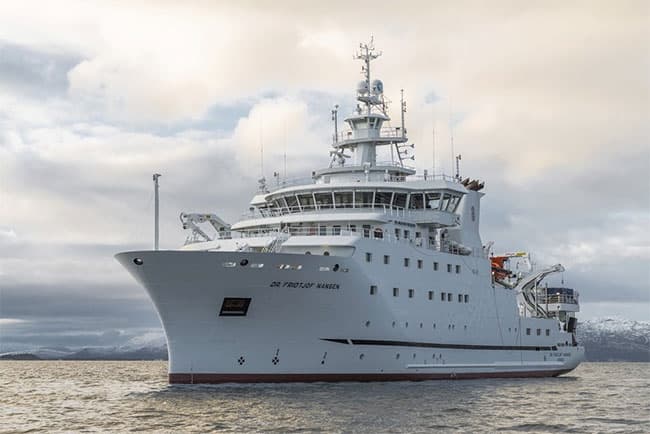


The United Nations-flagged vessel R/V Dr. Fridtjof Nansen under the Food and Agriculture Organization (FAO) is scheduled to arrive in Sri Lanka today (11) to conduct a marine scientific survey in Sri Lanka’s Exclusive Economic Zone (EEZ), the Ministry of Foreign Affairs said in a statement.
The vessel will arrive in the country on an invitation of the Government of Sri Lanka, and will conduct the survey in collaboration with the Ministry of Fisheries, Aquatic and Ocean Resources and the National Aquatic Resources Research and Development Agency (NARA).
R/V Dr. Fridtjof Nansen supports countries in collecting critical scientific data for sustainable fisheries management and in understanding how climate change is affecting marine ecosystems. The survey spanning 32 days will focus on assessing marine living resources and marine ecosystems, providing updated scientific data that will support Sri Lanka’s sustainable fisheries management and ocean governance.
During the mission, scientists will undertake a range of activities including hydro-acoustic surveys to estimate the biomass and distribution of key fish stocks in Sri Lankan waters; assessment of marine pollution levels; and biodiversity monitoring, the Foreign Ministry noted.
The mission will also bring together Sri Lankan scientists from NARA and other national institutions with international experts, promoting scientific collaboration and knowledge exchange.
Sri Lanka previously hosted the R/V Dr. Fridtjof Nansen in 2018, when the vessel conducted a comprehensive survey of Sri Lanka’s continental shelf and upper slope in collaboration with national institutions. Earlier Nansen surveys were also carried out in Sri Lankan waters in 1978–1980, reflecting a long-standing scientific partnership under the Nansen program.
Sri Lanka’s participation in this survey reflects the country’s continued commitment to sustainable fisheries, marine ecosystem protection, and international scientific cooperation in the Indian Ocean region, according to the Foreign Ministry.