


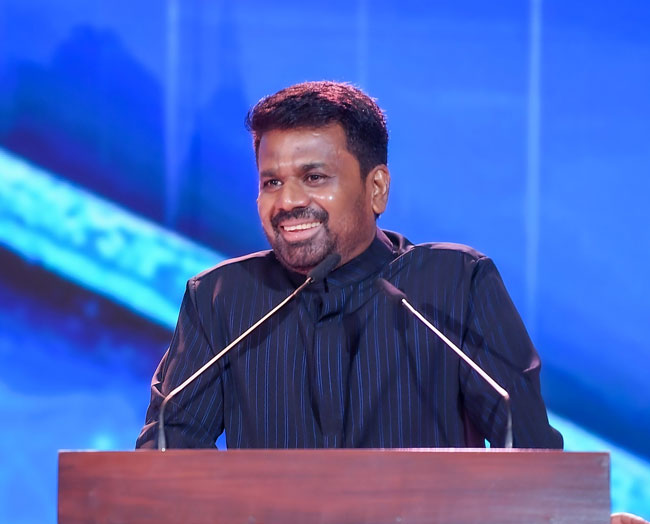
President urges collective action to tackle economic impact of Middle East crisis
March 11, 2026 04:48 pm
President Anura Kumara Dissanayake stated that the objective of the present government is to build in Sri Lanka an economy shaped by the advancements of science and technology in this era and invited the entire business community to join in strengthening the national economy by making the fullest use of these new economic opportunities.
Emphasising that the government is prepared to provide all necessary facilities for this purpose, the President also stated that it is the aim of the present government to bring back to the country the economic opportunities that the nation missed due to its failure to move forward in line with the modern world.
The President pointed out that the government has prepared a comprehensive plan for this purpose and that digitalisation is a key component of it.
The President further noted that attention has been given to economic opportunities such as artificial intelligence and data centres. He also stated that nearly Rs. 6.5 billion has been allocated in this year’s budget for digitalisation and that it is expected to issue the Digital Identity Card before the end of this year.
President Anura Kumara Dissanayake made these remarks while attending the Chamber of Lankan Entrepreneurs (COYLE) 2026 Annual General Meeting held in Colombo last afternoon (10) , according to the President’s Media Division (PMD).
This year’s Annual General Meeting was held under the theme “Bridging Generations, Building Futures”.
The President pointed out that any economy progresses on the basis of confidence in it and those entrepreneurs, those working in the financial sector and the general public must have confidence in the economy. The President also noted that distrust invariably leads to the collapse of economies.
The President stated that what the country needs today is a stable economy capable of withstanding both external and internal shocks and that such an economy is currently being built, the PMD said.
The President noted that although internal shocks have been overcome, the country is currently facing an external shock due to the war situation in the Middle East. Since the beginning of March, the price of a barrel of crude oil has increased by about 42 per cent, creating significant uncertainty in the global market. He added that uncertainty can also be observed in consumer behaviour in Sri Lanka, citing as an example the increase in diesel sales from 4,500 kilolitres on 1 March to 10,500 kilolitres by 3 March.
President Anura Kumara Dissanayake pointed out that while the crisis in 2022 arose due to a shortage of US dollars, the current situation is a supply crisis caused by disruptions in supply chains. He stated that this challenge can be overcome if everyone responds collectively rather than individually. He further noted that the government has established an “Economic Monitoring Committee” to address the crisis and is holding discussions with friendly countries to maintain supply chains.
The President also commended the role played by the Chamber of Lankan Entrepreneurs, which represents the emerging entrepreneurial leadership of Sri Lanka, as a significant contributor to the country’s economy and extended his congratulations to its new Chairman and all members.
The new Chairman of the Chamber of Young Lankan Entrepreneurs, Mr.Suren Chandraratne, as well as former Chairman Mr. Manjula Wijesundara and Senior Vice Chairman, Dan de Silva, also expressed their views at the event.
The new Chairman, Suren Chandraratne, stated that his expectation is to create a new tomorrow for emerging entrepreneurs.
Commenting further, President Anura Kumara Dissanayake stated:
“There has been a long-standing relationship between this COYLE forum and myself personally. At that time, you presented me with a series of questions regarding our policies and the strategies we intended to follow. It has now been more than a year since we assumed power. If you had questions then, do you still have them today? If there were doubts regarding our economic policies, I believe those doubts have now been resolved. What remains now is to face the challenges before us successfully and transform our motherland into a victorious state. I believe that the discussion you are having now is about the measures we are taking to achieve that.
We all know that our country experienced a major collapse a few years ago. After an economic collapse, nothing remains intact; everything comes to a standstill. Therefore, we all have a bitter recent experience of how destructive the collapse of an economy can be to the social fabric. Accordingly, the first responsibility entrusted to us as a government was to restore confidence in the economy. In order to move an economy forward, people must believe in its momentum. Confidence in the economy must be built among businesspeople and industrialists.
Even when we assumed power, the country had already entered into an Extended Fund Facility programme with the International Monetary Fund. That programme introduced certain targets and parameters. Even aside from those parameters, there are several indicators that help build confidence in an economy. I believe that through these indicators we have achieved highly successful outcomes that exceed both the parameters linked to the IMF programme and the targets we ourselves expected.
Among these achievements are recording the lowest budget deficit in Sri Lanka’s history in 2025, bringing the current account balance into surplus, achieving government revenue of 17.2 per cent in 2025 after several decades and making 2025 the year with the highest foreign remittances received by Sri Lanka. Therefore, the country’s economy is now stable. However, what we need is a resilient economy. We must create an economy capable of withstanding both external and internal shocks. If an economy collapses in the face of such shocks, it cannot remain stable. Accordingly, we are now building an economy that can withstand such internal shocks.
However, at present we are facing an external shock. The war situation in the Middle East is disrupting the supply of goods and services. The world is interconnected through markets. In such an interconnected global system, any shock arising in one sector affects us as well. Therefore, the key question is how we withstand these external shocks.
At the beginning of March, a barrel of crude oil was priced at approximately USD 70. It has now risen to around USD 100, representing an increase of roughly 42%. Oil prices continue to fluctuate significantly, creating a climate of uncertainty worldwide. This situation has impacted all nations, generating economic pressures and in some cases, social strain. It is important to note that citizens are not to be blamed for these challenges. The consequences of fuel and gas shortages have been experienced directly by the population. In response, citizens have been lining up at fuel stations. Sales of diesel began with 4,500 litres on the first day of March and increased to 10,500 litres by 3 March.
Petrol sales initially rose from around 4,000 kilolitres to approximately 9,000 kilolitres, but have now fallen back below 6,000 kilo litres. Therefore, it is important to emphasise that no individual can remain safe or unaffected in isolation. If everyone collectively takes responsibility and acts together to address this challenge, it is only through such shared effort that we can overcome it for the benefit of all.
These external shocks are exerting a tangible impact on us, which has necessitated an increase in fuel prices. Approximately 47% of our fuel market is controlled by external entities, which makes it essential to establish trust with them. At the same time, it is important to bring fuel availability back to normal consumption levels. The recommendation is that, through collective effort, we should work together to reduce further for the benefit of all.
The 2022 crisis arose not because global supply routes were disrupted or fuel reserves were attacked, but due to a shortage of dollars to procure fuel. Today, however, that problem no longer exists, as we now have foreign reserves of USD 7.2 billion. Consequently, any future crisis would only occur as a result of disruptions in supply routes. In anticipation of such risks, discussions are underway with friendly nations to secure alternative channels. It is the government’s responsibility to ensure an uninterrupted supply of energy. Any disruption would cause the significant economic gains we have achieved in a short period to stall. Therefore, the government’s comprehensive plan focuses on guaranteeing continuous energy supply.
Continuous energy supply can now be assured. However, it is only possible to forecast and guarantee this reliably for a maximum period of two months. If the conflict persists beyond this two-month window, predictions based on current assessments will no longer hold.
This is an era in which technology and science have given unprecedented power to warfare. As a result, it is impossible to predict the impact of such advanced military operations over the long term. Short-term forecasts are possible, but if the conflict continues beyond that period, no one can reliably predict the outcomes. Therefore, assurance can be provided that energy supply will be maintained over the next two months, however, prices may fluctuate. I am neither an owner of an oil well nor a representative of any oil company. These actions are not undertaken for personal profit. However, as a government, there is a responsibility to ensure an uninterrupted supply of energy.
All necessary measures have been put in place to manage internal pressures effectively. We have been able to address these domestic challenges, but confronting external shocks will require additional time. We are currently navigating a path of recovery and progress, which naturally entails encountering certain pressures. However, these challenges are being carefully managed and efforts are on-going to mitigate their impact. It is essential that everyone collectively faces these pressures, acting with consideration not only for oneself but for the welfare of the entire community. Consequently, some adjustment to consumption patterns is necessary. Unlike stable economies, nations facing global crises cannot rely solely on habitual consumption practices. In times of crisis, restraint and prudent economic behaviour are indispensable. I urge everyone to adopt a degree of moderation and participate in careful economic practices. By doing so collectively, we can successfully navigate this crisis and emerge stronger.
A long-term plan has also been developed, with digitalisation forming a central component. Historically, our nation has missed significant opportunities. The world continuously generates new economic prospects through advancements in science and technology. Over the past century, we have witnessed remarkable innovations across various scientific and technological fields globally. However, parallel to this progress, our nation has struggled to keep pace with technological and scientific development. As a result, we have not been able to advance alongside the rest of the world. In the current era, digitalisation, artificial intelligence and data centres represent key technological platforms that create new economic opportunities. It is therefore essential that we capitalise on these opportunities. As a government, every effort is being made to harness advancements in science and technology to rebuild and strengthen the nation’s economy in this new era.
Digitalisation must be pursued on a large scale and significant effort is being invested to achieve this. Under the current budget, approximately LKR 6.5 billion has been allocated for digital initiatives. It is anticipated that, before the end of this year, digital identity cards will be issued. This will allow for the minimisation of inefficiencies and delays within the state mechanism, enhancing overall administrative effectiveness.
Work is currently underway to transform the entire state apparatus. In this endeavour, the significant driving force of the nation’s economy is in your hands. Expand your business twofold or threefold. The role of the government is to provide all the necessary services and support to enable this growth. Every individual is encouraged to grow their business by 100% over the next two to three years, thereby becoming a key contributor to the national economy.”
The occasion was also attended by a delegation of Ministers from both the ruling and opposition parties, including the Minister of Energy, Mr. Kumara Jayakody, alongside members of the Chamber of Lankan Entrepreneurs, namely the newly appointed Chairman Suren Chandrarathne, outgoing Chairman Manjula Wijesundara and Senior Vice Chairman, Dan de Silva, among other Chamber members.



