

IMF cautions countries against broad fuel subsidies to deal with war-driven energy shock
April 15, 2026 10:01 pm
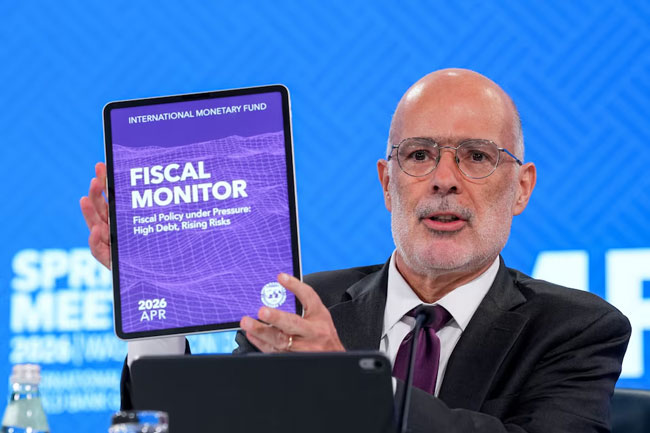
The war in the Middle East has intensified strains on an already fragile global fiscal situation, with higher interest rates and rising energy prices already fueling calls for support from emerging markets and developing economies, the International Monetary Fund said on Wednesday in its Fiscal Monitor report.
Rodrigo Valdes, the IMF’s new fiscal affairs chief, said countries should skip fuel subsidies to help their citizens deal with a shortage of oil and the corresponding surge in energy prices and opt instead for targeted, temporary cash transfers that do not obscure higher prices and keep demand high.
‘‘We don’t have oil. We don’t have energy. Energy needs to be more expensive for everybody, so that the adjustment happens and we consume less,’‘ Valdes told Reuters in an interview.
The IMF on Tuesday cut its growth outlook due to war-driven energy price spikes and supply disruptions, saying the global economy could be driven to the brink of recession if the war widens and oil stays above $100 per barrel through 2027.
‘‘You can pass through (higher energy prices) and then you can do other things to help,’‘ Valdes said. ‘‘It’s a global shock and if countries suppress the price signal, the global price will be higher ... It’s very important to give price signals so demand can adjust."
Era Dabla-Norris, deputy fiscal affairs director, said in a news conference the response thus far had been more restrained than during the energy price shock of Russia’s invasion of Ukraine in 2022.
‘‘Countries are not necessarily coming out in full force with huge packages,’‘ Dabla-Norris said. ‘‘In an environment ... where fiscal space is much more constrained and governments are facing many different trade-offs, not just in the near term, but also over the medium term, choosing a sort of more disciplined way of cushioning the impact is what we are advocating."
Valdes said imposition of export controls, the extent of damage to energy infrastructure and the capacity of other countries to boost oil output would determine the war’s impact, and its policy implications.
Once the current strains eased, he said it was critical that countries stay focused on medium-term challenges in an environment where public debt continued to increase, driven by expanded permanent spending on entitlement programs or reduced revenues, particularly in some of the largest economies.
The IMF’s advice was simple: ‘‘Rebuild fiscal buffers once conditions stabilize and do so without delay."
Global government debt reached 93.9% of gross domestic product (GDP) in 2025, up nearly two percentage points from 92% a year earlier, and was expected to reach 100% of GDP by 2029, a year earlier than expected just a year ago, according to the IMF’s latest Fiscal Monitor.
That would mark the highest government debt burden since the aftermath of World War Two, the report said. Government debt was expected to keep rising and could reach 102.3% of GDP by 2031, it added. It could reach 121% of GDP in three years, if the IMF’s severe economic scenario comes to pass, Valdes said.
Interest payments had also risen sharply, hitting nearly 3% of GDP in 2025, up from 2% four years ago, the IMF said.
Valdes warned of emerging risks, including a reshaping of debt markets that gives a larger role to investors such as hedge funds, who he said were ‘‘less firm hands to hold debt for the long run.’‘ The duration of debt had also been declining, which meant that short-term interest rates transmitted more quickly to debt dynamics.
Other challenges included higher security costs, energy and climate transition spending and rising interest bills at a time when revenues had not kept pace, the IMF said in a blog accompanying the report.
Trade and financial fragmentation could further sap growth and push up borrowing costs, while political instability may undermine reforms and revenue collection. Abrupt shifts in markets, including in AI stocks, could tighten financial conditions quickly.
Valdes said countries needed to start working on fiscal consolidation once the immediate crisis was resolved.
‘‘There are some countries that are taking this seriously but in many others we don’t see yet a plan that is spelled out,’‘ he said, adding that even those with plans still had more work to do.
‘‘We’re not at a crisis point ... but the more you delay the measures, the steeper will be the effort that you need, and the higher the risk of having a disorderly consolidation later."
Source: Reuters
-Agencies