






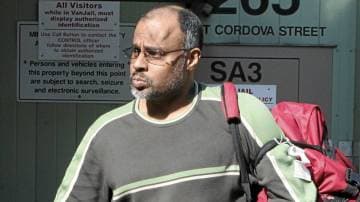


Prapaharan Thambithurai, first in Canada to be charged, will enter plea Tuesday in B.C. court
Federal terrorism financing legislation will be on trial Tuesday when the first person in Canadato be charged with raising funds for a banned terrorist organization stands up in a B.C. courtroom and enters a plea.
Prapaharan Thambithurai was charged in March, 2008, in Vancouverwith soliciting funds for the Liberation Tigers of Tamil Eelam, a terrorist group officially banned in Canadain 2006.
The court has been told that Mr. Thambithurai will enter a plea and will be ready for sentencing. But neither the prosecution nor the defence have said how Mr. Thambithurai intends to plead.
“I really cannot confirm anything other than we will find out [Tuesday] morning at 10 o’clock in B.C. Supreme Court,” Dan Brien, a spokesman for the Public Prosecution Service of Canada, said Monday in an interview.
“Until it happens in court I cannot make any guarantees that a person is going to stand up and plead a certain way,” he said.
When Mr. Thambithurai was charged two years ago, his lawyer, Richard Peck, said his client was actually raising funds for the World Tamil Movement, which was not banned in Canada. The WTM was a humanitarian organization that helped people in need in Sri Lanka, Mr. Peck said. However, the police alleged the WTM was a front for the Tamil Tigers.
The Sri Lankagovernment crushed the Tamil Tigers last year, ending a bloody fight for Tamil independence that claimed tens of thousands of lives over more than 30 years.
Mr. Peck did not return a phone call Monday.
The outcome of the B.C. case is being keenly watched by Canada’s law-enforcement community, whose efforts to curtail terrorist financing are considered lacklustre. Canada’s financial-intelligence agency, FINTRAC, says that every year dozens of terrorist-financing cases come to light and millions of dollars may flow abroad. Yet Canadahas never successfully prosecuted a standalone terrorism-finance case.
If Mr. Thambithurai pleads guilty and receives a reduced sentence, the terrorism financing legislation could come under intense criticism.
A plea arrangement would expose a glaring weakness in the legislation, said John Thompson, president of the Mackenzie Institute, a Toronto-based think tank concentrating on terrorism, political extremism and organized crime.
“The legal standard to prove cases of international money laundering for terrorist organizations is very, very difficult to achieve,” Mr. Thompson said in an interview. “I can see where the Crown [prosecutor] would want to take the shortcut,” he said.
University of Toronto associate professor Wesley Wark, a national security policy expert, said a plea bargain would indicate the legislation is working in the way it was intended.
Difficulty in obtaining a conviction was intended to push the prosecution and the accused to reach a compromise, he said. “You are not really interested in rounding up people who gave $100 to the Tamil Tigers. What you are really interested in is access to wider knowledge about the terrorist groups, whether it is Tamil Tigers or others,” Prof. Wark said.
The legislation was intended to help investigators find out more about terrorist groups, their activities and those involved in the schemes, he said. “The general feeling is that [prosecuting] terrorism financing is a way into the heart of terrorism plots and terrorism groups, Prof. Wark said.
There is one financing conviction on the books since the legislation was adopted in 2001, but that case did not involve a banned terrorist organization. An al-Qaeda sympathizer in Ottawa was convicted in 2007 of sending small sums of money to terrorists in the United Kingdom and Pakistan. But the meat of that case was about building bombs: Momin Khawaja was found guilty of building detonators.
theglobeandmail