

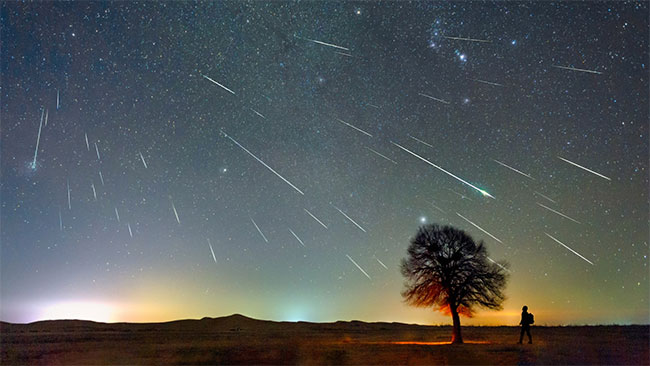
Largest meteor shower of 2025 visible tonight and tomorrow
August 12, 2025 12:34 pm
The largest meteor shower of 2025 will be visible from midnight today (12) and into early hours of tomorrow, according to Astrophysicist and Engineering Lecturer Gihan Weerasekera.
He explained that this meteor shower, known as the Perseids, is named after the Perseus constellation in which it appears.
The phenomenon will be best observed from the northern sky at around 5:00 a.m. tomorrow, according to experts.
“The special feature of this meteor shower is that around 100 meteors can be seen in an hour, which is considered a large number. Such high meteor counts are rare and occur only in a few meteor showers,” Astrophysicist Gihan Weerasekera said.
The Perseus constellation generally becomes visible above the horizon around midnight and rises steadily until dawn.
“Therefore, the optimal viewing time is around 5:00 a.m., when observers looking towards the north will be able to witness up to 100 meteors in an hour,” Weerasekara stated.
The Perseids meteor shower is one of the brightest and most popular meteor showers of the year.
This annual shower remains active from mid-July through late August, but it will peak today and tomorrow, and stargazers can expect to see up to 60 to 100 meteors per hour, weather permitting.
According to NASA, the Perseids meteor shower is caused by Comet Swift-Tuttle. This comet is the largest object known to repeatedly pass near Earth, with a nucleus approximately 16 miles wide.
When looking up during a meteor shower, viewers are watching tiny bits of debris left behind by comets. As these particles enter Earth’s atmosphere, they heat up and burn brightly, creating streaks of light across the sky which are commonly called shooting stars.
These vivid pieces of space debris can travel at speeds of up to 37 miles per second, according to NASA.
The American Meteor Society recommends finding a dark location away from city lights and looking in the opposite direction of the moon for the best visibility. Although the meteors can appear anywhere in the sky, they seem to radiate from the constellation Perseus, located in the northeastern part of the sky, NASA stated.
--With Agencies Inputs--