
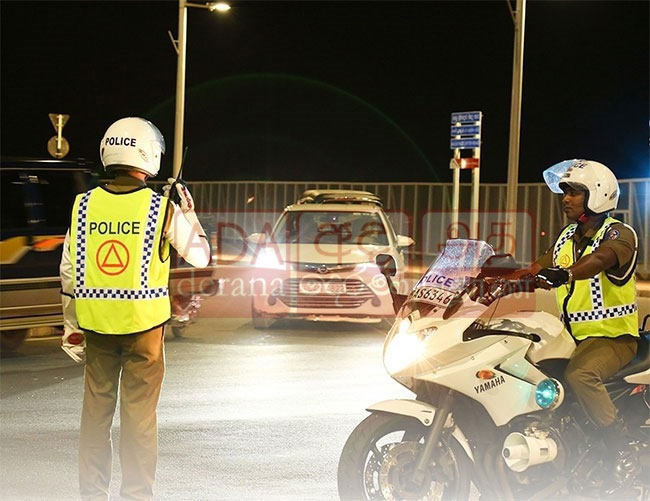
New directive issued on testing drivers under the influence of narcotics
September 21, 2025 06:07 pm
A new directive outlining the procedure that police officers must follow when inspecting drivers suspected of operating vehicles under the influence of narcotics has been issued by the Ministry of Transport, Highways, Ports, and Civil Aviation.
This new directive has been issued under Section 151 of the Motor Traffic Act and is in effect from September 1.
The directive details the steps police officers should take when there are reasonable grounds to suspect that a driver is under the influence of drugs.
Accordingly, if a police officer reasonably suspects that a driver is under the influence of drugs based on unusual skin reactions, abnormal behavior, the driver’s speech, actions, movements, balance, or appearance of the eyes, the officer is authorized to refer the driver for testing.
In such instances, if it is determined that the driver is under the influence of drugs, the police officer has the authority to refer the driver for a test. Approved testing equipment is to be provided to police officers for the testing, the Transport Ministry said.
This test should be conducted either at a police station or another suitable location, and it must be done out of public view, as specified in the directive.
If for any reason the driver refuses to provide a sample for the test, the directive states that the driver must be immediately presented to a government medical officer or an authorized official for examination.
If, after the initial test, the police officer is reasonably satisfied that the driver has used a drug or a combination of drugs, the driver should be referred without delay to a government medical officer or a qualified official at a government hospital for further testing.
Accordingly, the directive specifies that the driver must, upon request from such medical professionals, provide a sample of blood, urine, saliva, or any other bodily fluid.
If subsequent laboratory testing of these samples confirms drug use, the final report issued by the government medical officer will serve as the basis for taking legal action. The authority to initiate such legal proceedings lies with the Officer-in-Charge (OIC) of the police station or a police officer authorized by the OIC, as stated further in the directive issued by the Ministry of Transport, Highways, Ports, and Civil Aviation.