
US announces $11 billion arms package for Taiwan, largest ever
December 18, 2025 09:33 pm
The Trump administration announced on Wednesday $11.1 billion in arms sales to Taiwan, the largest ever U.S. weapons package for the island which is under increasing military pressure from China.
The Taiwan arms sale announcement is the second under U.S. President Donald Trump’s current administration, and comes as Beijing ramps up its military and diplomatic pressure against Taiwan, whose government rejects Beijing’s sovereignty claims.
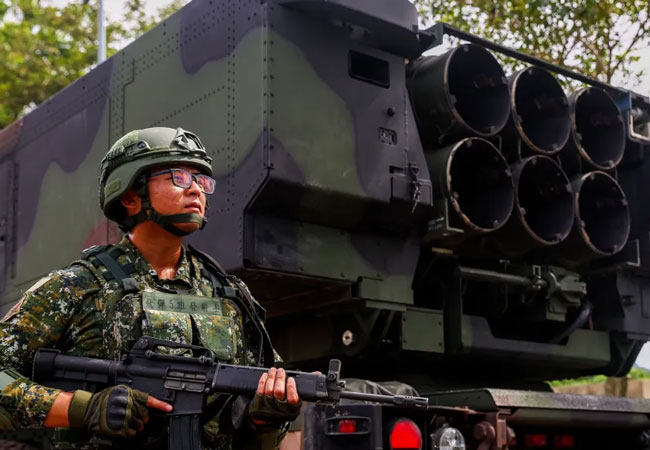
The proposed arms sales cover eight items, including HIMARS rocket systems, howitzers, Javelin anti-tank missiles, Altius loitering munition drones and parts for other equipment, Taiwan’s defence ministry said in a statement.
“The United States continues to assist Taiwan in maintaining sufficient self defence capabilities and in rapidly building strong deterrent power and leveraging asymmetric warfare advantages, which form the foundation for maintaining regional peace and stability,” it added.
The package must be approved by the U.S. Congress, where Taiwan has widespread cross-party support.
In a series of separate statements announcing details of the weapons deal, the Pentagon said the arms sales serve U.S. national, economic and security interests by supporting Taiwan’s continuing efforts to modernise its armed forces and to maintain a “credible defensive capability”.
Pushed by the United States, Taiwan has been working to transform its armed forces to be able to wage “asymmetric warfare”, using mobile, smaller and often cheaper weapons which still pack a targeted punch, like drones.
“Our country will continue to promote defence reforms, strengthen whole of society defence resilience, demonstrate our determination to defend ourselves, and safeguard peace through strength,” Taiwan presidential office spokesperson Karen Kuo said in a statement, thanking the United States for the sales.
Taiwan President Lai Ching-te last month announced a $40 billion supplementary defence budget, to run from 2026 to 2033, saying there was “no room for compromise on national security”.
China’s foreign ministry expressed anger, as it does with all U.S. arms sales to Taiwan, saying the deal “severely undermines peace and stability in the Taiwan Strait” and demanded an end to such deals.
“By aiding ‘Taiwan independence’ with weapons, the U.S. side will only bring fire upon itself; using Taiwan to contain China is absolutely doomed to fail,” ministry spokesperson Guo Jiakun said in Beijing.
Rupert Hammond-Chambers, president of the U.S.-Taiwan Business Council, said weapons like the HIMARS, which have been used extensively by Ukraine against Russian forces, could play an essential role in destroying an invading Chinese force.
“This bundle of congressional notifications, a record in U.S. security assistance for Taiwan, is a response to the threat from China and the demand from Mr. Trump that partners and allies do more to secure their own defence,” he added.
FOREIGN MINISTER’S US VISIT
The announcement followed an unannounced trip by Taiwan’s Foreign Minister Lin Chia-lung to the Washington area last week to meet U.S. officials, according to two sources who spoke to Reuters on condition of anonymity.
Reuters was unable to determine the agenda of the meetings and Taiwan’s foreign ministry declined to comment.
Washington has formal diplomatic ties with Beijing, but maintains unofficial ties with Taiwan and is the island’s most important arms supplier. The U.S. is bound by law to provide Taiwan with the means to defend itself, though such arms sales are a persistent source of friction with China.
Trump’s penchant for dealmaking and his planned visit to meet Chinese President Xi Jinping next year, have kindled fears in the region of weakening U.S. support for Taiwan.
But U.S. officials told Reuters at the outset of Trump’s second term this year that they had plans to ramp up weapons sales to Taipei to a level exceeding Trump’s first term, as part of an effort to deter China.
The Trump administration’s national security strategy unveiled earlier this month said the U.S. aimed to deter conflict over Taiwan by “preserving military overmatch” against China in the region, language welcomed in Taipei.
The strategy also highlighted Taiwan’s strategic importance due to its location dividing “Northeast and Southeast Asia into two distinct theatres”.
China views Taiwan as its own territory, a position Taipei rejects.
Source: Reuters
--Agencies