
AI could be smarter than all of humanity in five years, says Elon Musk
January 23, 2026 04:27 pm
Tesla CEO Elon Musk said artificial intelligence (AI) is on track to become smarter than all of humanity combined within the next five years — a shift he believes will change how people work, move and even find purpose.
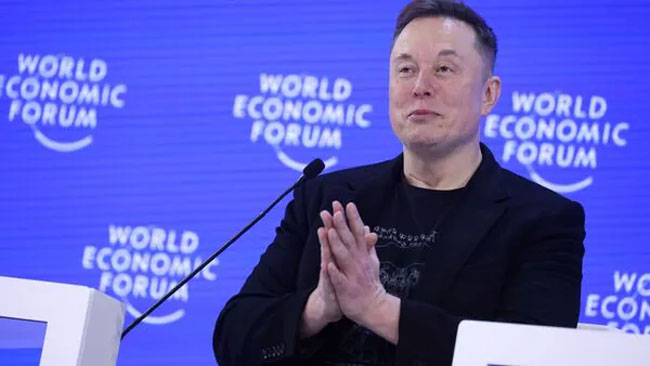
Speaking at the World Economic Forum in a conversation with BlackRock CEO Larry Fink, Musk said AI is advancing faster than many expect. He predicted that AI could be “smarter than any individual human this year,” and become “smarter than all of humanity combined” within the decade.
Musk linked that trajectory to the rise of humanoid robots, which he said could dramatically expand economic output. Tesla’s Optimus robots, he said, are already performing simple tasks in factories, with more advanced capabilities expected soon.
“If things go well, we expect to sell humanoid robots to the public by the end of next year,” Musk said, adding that safety would be critical before any wider rollout.
On autonomous driving, Musk said Tesla’s Full Self-Driving software has reached a level where insurers are offering significant discounts to customers using it. He said Tesla is seeking regulatory approval to expand supervised self-driving in Europe, potentially as early as next month, followed by China.
“If regulated and supervised, it will be widespread,” Musk said.
While much of the discussion focused on AI’s potential, Musk warned that energy — not computing power — could become the biggest constraint on progress. He said electricity generation is not scaling fast enough to keep pace with AI infrastructure, particularly in the United States.
“AI chips are being produced faster than we can power them,” Musk said, pointing to solar energy as the most viable solution at scale. He noted that China is deploying solar capacity far more rapidly, while tariffs and policy barriers are slowing adoption elsewhere.
Looking further ahead, Musk said space could ultimately be the cheapest place to run large-scale AI systems. Solar panels in orbit, he said, generate more energy than those on Earth, while the cold vacuum of space offers natural cooling for data centres.
“The lowest-cost place to put AI will be space,” Musk said, predicting that solar-powered AI infrastructure in orbit could emerge within the next few years.
Musk also spoke about SpaceX’s efforts to achieve full rocket reusability with its Starship vehicle, which he said could reduce the cost of access to space by a factor of 100 if successful.
Asked what continues to motivate him, Musk pointed to curiosity and a desire to understand reality. When asked whether he would personally go to Mars, he replied: “Yes, but just not on impact.”
Source: Economic Times
--Agencies