
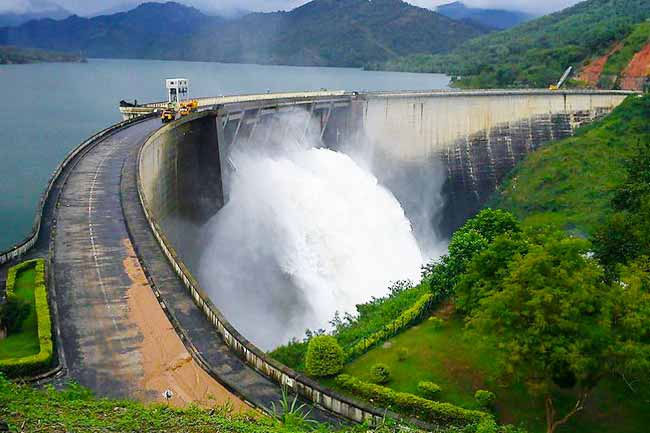
FSP claims unusual release of Victoria Reservoir’s water for electricity generation
April 15, 2026 08:25 pm
The Frontline Socialist Party (FSP) alleges that the government has decided to release water from the Victoria Reservoir in an unusual manner for electricity generation.
Speaking at a media briefing held in Nugegoda today (15), FSP Propaganda Secretary Duminda Nagamuwa claimed that the move was proposed as a response to reduced thermal power generation caused by the import of substandard coal.
He said the decision was reportedly made during a meeting held on March 24, chaired by Ministers K.D. Lalkantha and Kumara Jayakody, with the participation of relevant officials.
According to Nagamuwa, the decline in electricity generation at the Norochcholai Coal Power Plant due to poor-quality coal has forced increased reliance on costly diesel-powered generation.
He alleged that, in order to avoid public backlash over higher electricity costs, the government has opted for alternative measures, including increased use of reservoir water.
He further claimed that the water level of the Victoria Reservoir, which must be maintained at around 422 metres above sea level for drinking water requirements, is now being reduced due to what he described as ‘‘arbitrary decisions’‘.
As a result, he stated that the Balagolla Barrage pumping station, which supplies drinking water to areas including Kandy, Kundasale and Digana, is at risk of becoming non-operational.
He also noted that approximately 17,000 water supply connections are currently facing disruptions. Although water is being distributed using bowsers, he said the daily demand of around 12,000 cubic metres is being met with only about 500 cubic metres.
He further added that several factories in the Polgahawela Export Processing Zone have already been forced to suspend operations due to water shortages, as production targets cannot be met.
He further warned that the situation could affect water management across the Randenigala Reservoir and Rantambe Reservoir systems, potentially impacting agriculture.
Calling on the government to reverse what he described as a ‘‘reckless decision,’‘ he urged immediate corrective action to prevent further deterioration of the crisis.