

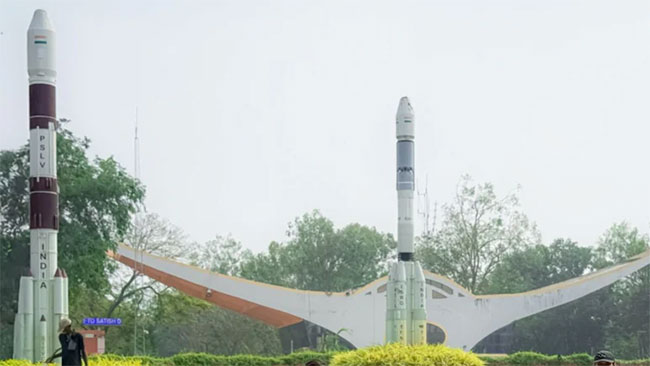
ISRO spy satellite launch tomorrow to boost India’s private space ecosystem
January 11, 2026 06:10 pm
The Indian Space Research Organisation (ISRO) will launch its 64th Polar Satellite Launch Vehicle (PSLV) mission tomorrow, marking a critical moment for India’s space program and signalling the rise of the country’s private space ecosystem.
The mission, designated PSLV-C62 / EOS-N1, will lift off from the Satish Dhawan Space Centre, Sriharikota, at 10.17 am. This flight will carry a total of 15 satellites, including a highly classified surveillance satellite named Anvesha, developed by the Defence Research and Development Organisation (DRDO). The Anvesha satellite is designed to provide cutting-edge imaging capabilities, enabling India to map enemy positions with pinpoint accuracy.
Beyond the strategic payload, this mission is historic for another reason: India’s private space sector is stepping into the limelight. For the first time, a single Indian private company, Dhruva Space, based in Hyderabad, is contributing seven satellites to the mission.
ISRO’s Perspective: A Statement of Confidence
Dr V Narayanan, Chairman of ISRO, captured the essence of this milestone in an exclusive statement to NDTV. “India’s workhorse rocket will show what ISRO can do for user agencies. The main passenger protects India from the skies and the smaller co-passengers signify how India’s private space sector is flourishing with just one Hyderabad company Dhruva Space contributing to seven satellites, setting a new benchmark. The other eight co-passengers are also unique, including a re-entry module. The Department of Space is contributing to India’s growth story and touching human lives,” he said. His statement highlighted ISRO’s dual mission: safeguarding national security while nurturing a vibrant private space ecosystem.
The Mission In Detail
Main Payload: EOS-N1 Earth Observation Satellite for a user agency. Anvesha Surveillance Satellite by DRDO, equipped with advanced imaging for defense applications.
Co-Passengers: 15 satellites in total. 7 from Dhruva Space. 8 others, including international payloads from France, Nepal, Brazil, and the UK. A notable inclusion is KID (Kestrel Initial Technology Demonstrator) from a Spanish start up, a prototype re-entry vehicle slated to splash down in the South Pacific Ocean after completing its mission.
The PSLV-C62 mission will be the ninth dedicated commercial mission by NewSpace India Limited (NSIL), ISRO’s commercial arm, and the 64th PSLV flight overall.
Why This Launch Matters
The last PSLV mission in May 2025 ended in failure due to an anomaly in the rocket’s third stage. This upcoming launch is not just about deploying satellites but about restoring confidence in India’s most reliable launch vehicle and reinforcing ISRO’s reputation as a global player.
Moreover, the mission signals a paradigm shift. For decades, India’s space program was synonymous with ISRO. Today, private players like Dhruva Space are emerging as critical partners, offering end-to-end solutions from satellite design to deployment and even ground station services.
Dhruva Space: Leading The Private Sector Surge
Vishal Latha Balakumar, Director of Space Missions at Dhruva Space, on being asked if he was jittery on launching on a PSLV immediately after a previous failed mission, said, “Absolutely not. PSLV has always been reliable and it stays to be. So, we are having a whole bunch of missions on them. We have 5 deployers with 7 different missions, 7 different satellites that we are launching on a single launch right now.”
This confidence also reflects Dhruva Space’s growing capabilities. The company is helping in deploying seven satellites a feat never before achieved by an Indian private firm. These satellites include Thibolt-3, designed for connectivity and remote monitoring, and several student-built satellites developed in collaboration with universities like Dayanand Sagar University (Karnataka), CV Raman Global University (Odisha), and Assam Don Bosco University.
Explaining the significance, Balakumar added, “This is a very exciting mission for us where we are bringing in multiple aspects of a complete space mission together. We have built some of these satellites. We are supplying deployers for all of the missions that we are deploying as part of this mission. And for certain missions on these satellites, we are also providing ground station as a service.”
Dhruva Space is not just launching satellites, it is pioneering ground station as a service, having secured the first license from IN-SPACe, an autonomous agency under the Department of Space. This service will support missions like IUSAT (Orbit8) and MOI-1 (TM2 Space), enabling seamless operations for domestic and international customers.
Technical, Strategic Impact
The Anvesha satellite, developed by DRDO, is the crown jewel of this mission. With advanced imaging capabilities, it will bolster India’s surveillance infrastructure, providing real-time intelligence for defense and strategic planning. In an era of heightened geopolitical tensions, this asset strengthens India’s deterrence posture.
Meanwhile, the inclusion of international payloads, from France, Nepal, Brazil, and the UK-underscores India’s growing stature as a preferred launch destination. The PSLV’s track record, including the 2017 world record of launching 104 satellites in a single mission, continues to attract global customers.
Looking Ahead
Dhruva Space has ambitious plans beyond this launch. “We have always had large plans we’ve been building larger platforms, 50 kilogram platforms, which was launched a couple of months ago. We’re building more missions on that side of things. Larger platforms, more than 100 kilogram platforms are also missions that we’re building currently. And a lot more is in the pipeline for us,” Balakumar said.
This trajectory aligns with India’s vision of becoming a global hub for space technology and services. With reforms opening doors for private participation, the country is witnessing the birth of a full-stack space ecosystem, spanning satellite manufacturing, launch services, and ground infrastructure.
A New Era For Indian Space
The PSLV-C62 mission is more than a launch - it signals ISRO’s resilience, India’s strategic resolve, and the private sector’s coming of age. As Dr Narayanan aptly put it, this mission is about “touching human lives while securing the nation and empowering industry”.
If successful, the launch will mark a turning point, paving the way for greater collaboration between ISRO and private players, and positioning India as a formidable force in the global space economy.
Source: NDTV
- Agencies