


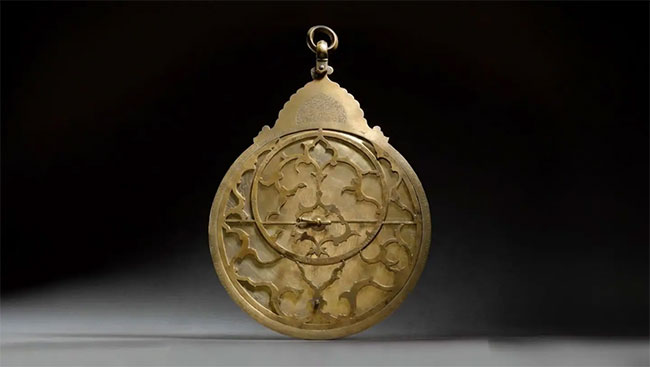
A 17th Century ‘supercomputer’ once owned by Indian royalty sells for record in auction
May 1, 2026 03:21 pm
A spectacular brass astrolabe - or a hand-held astronomical computer - from the 17th Century, once part of the royal collection of Jaipur city in western India, has been sold for more than £2m ($2.75m) at an auction in London.
This has set a record for the auction of an astronomical instrument from the Islamic world, a representative from Sotheby’s, which held the auction, told the BBC. It was exhibited at the auction house’s London galleries this week.
The object is “perhaps the largest in existence” and had never been exhibited before, Benedict Carter, head of the department of Islamic and Indian Art at Sotheby’s, told the BBC.
Known to be part of the royal collection of Maharaja Sawai Man Singh II of Jaipur, it was passed on to his wife Maharani Gayatri Devi, one of the most glamorous women of her time, after his death. It then moved to a private collection during her lifetime.
Astrolabes are metallic disks with multi-layered, interlocking components that were historically used to tell the time, map the stars, the direction of Mecca and the motion of the sky.
“They are essentially a two-dimensional projection of a three-dimensional universe. I compare them to modern-day smartphones because you can do so many things with them,” says Dr Federica Gigante of the Oxford Centre for History of Science, Medicine and Technology.
“You can calculate the time of sunset, sunrise, the height of a building, the depth of a well, distance and even use them to predict the future. Along with an almanac they were once used to cast horoscopes.”
Astrolabes were first developed in ancient Greece in the 2nd Century BCE and spread to the Islamic world by the 8th Century. Over the following centuries, centres of production flourished across Iraq, Iran, North Africa and al-Andalus (in present-day Spain).
This particular instrument was made in the early 17th Century in Lahore, now in Pakistan, at a time when the city had become a leading hub of astrolabe-making in the Mughal world. It was created by two brothers, Qa’im Muhammad and Muhammad Muqim, for a Mughal nobleman.
The pair were part of the so-called “Lahore School”, one of the most renowned centres of astrolabe production of its time. The craft itself was kept within a single family and passed down generations.
Only two astrolabes are known to have been jointly made by the brothers; the other, a much smaller one, is kept in a museum in Iraq.
This one was commissioned by Aqa Afzal, a nobleman who administered Lahore during this period. Originally from Isfahan in Iran, he held several senior posts under the Mughal emperors Jahangir and Shah Jahan. The object’s massive size and opulence reflect the patron’s stature.
“It weighs 8.2kg, measures nearly 30cm in diameter and stands about 46cm tall - almost four times the size of a typical astrolabe from 17th Century India,” said Carter.
“It also has a striking cross-cultural element. The star pointers carry their standard names in Persian, alongside Sanskrit equivalents etched in the Devanagari script.”
According to Sotheby’s, the piece contains 94 cities inscribed within it, each marked with their respective longitudes and latitudes, along with 38 star pointers linked by intricate floral tracery. It also features five precision-calibrated plates and degree divisions “so fine they are subdivided down to a third of a degree”.
This level of detail reflects the extraordinary craftsmanship of the Lahore School, which at the time was “at its most refined”, Carter says. Here, technical precision, functionality and artistic beauty converged in a way that set it apart from earlier astrolabes produced in parts of the Middle East, which might have only been functional.
The object also speaks to the broader scientific impulse of the Mughal court, where rulers and courtiers showed a heightened interest in the advances in astronomy and astrology.
“It is not only big, beautiful and heavy, it is so incredibly accurate that it will give you the exact degree of altitude [of a celestial body],” said Gigante.
She added that the only comparable instrument was likely one made for Abbas II of Persia.
Sotheby’s had said before the auction that the piece’s pristine condition and royal provenance was expected to attract keen interest from museums and collectors.
It broke the record held by a Ottoman astrolabe made for Sultan Bayezid II, which was a much smaller piece sold in 2014 for just under £1m.
Source: BBC
--Agencies



