




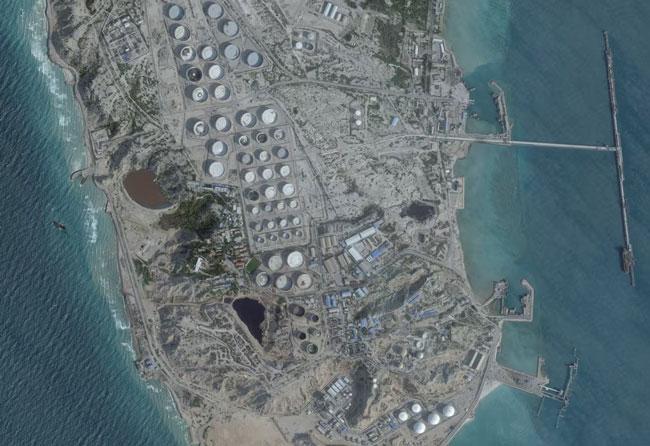



After US forces struck military targets on Iran’s main oil hub, Kharg Island, Iran’s Armed Forces’ unified combatant command warned on Saturday that any attack on the country’s oil and energy infrastructure would trigger retaliatory strikes on facilities owned by oil companies cooperating with the United States in the region, reported Reuters citing Iranian media.
US President Donald Trump said on Friday that American forces attacked military installations on Kharg Island but deliberately avoided striking oil export facilities.
In a Truth Social post, Trump said the US military had “totally obliterated every MILITARY target” on the island but had chosen to leave the oil infrastructure intact.
“However, should Iran, or anyone else, do anything to interfere with the free and safe passage of ships through the Strait of Hormuz, I will immediately reconsider this decision,” Trump wrote.
The confrontation has increasingly centred on the narrow waterway, which carries about a fifth of the world’s oil supply.
Iranian forces have already attacked vessels in the strait, fuelling volatility in global oil markets and raising fears of supply disruptions.
Speaking to reporters, the US President said the American Navy would soon begin escorting tankers through the Strait of Hormuz.
He described Iran’s attacks on shipping as “a last-ditch effort” and warned that US forces would continue to strike Iran “very hard over the coming week.”
Why Kharg Island matters
Kharg Island handles about 90% of Iran’s crude exports and is the backbone of the country’s oil shipping network.
The island lies roughly 300 miles (483 km) northwest of the Strait of Hormuz, making it a critical link between Iranian oil fields and global markets.
Because of its central role in Iran’s energy sector, the island has long been viewed as one of the most strategically sensitive oil facilities in the Middle East.
War spreads across the region
The war between Iran and Israel, now nearing two weeks, has spread across much of the Middle East.
Around 2,000 people have been killed, most of them in Iran, with casualties also reported in Lebanon and across the Gulf; while millions have been displaced as the conflict widens.
Israel has, meanwhile, also intensified its campaign against Iranian-linked targets.
Israeli warplanes have pounded Beirut’s southern suburbs, where Hezbollah is based, while the Israeli military said it struck more than 200 targets across western and central Iran in the past day, including ballistic missile launchers, air-defence systems and weapons production sites.
Iran has responded by firing more missiles and drones at Israel, while Iranian drones have also been reported entering the airspace of Kuwait, Iraq, the United Arab Emirates, Bahrain and Oman.
The United States is also increasing its military presence in the region.
Washington has further deployed the amphibious assault ship USS Tripoli and its Marine expeditionary unit, along with about 2,500 additional Marines and supporting naval forces.
However, US forces have not remained untouched from the growing conflict. The Pentagon confirmed that all six crew members aboard a KC-135 refuelling aircraft that crashed in western Iraq were killed.
With Kharg Island at the centre of Iran’s oil exports and tensions rising around the Strait of Hormuz, analysts warn the conflict could increasingly pivot toward energy infrastructure across the region.
Source: Economic Times
--Agencies