







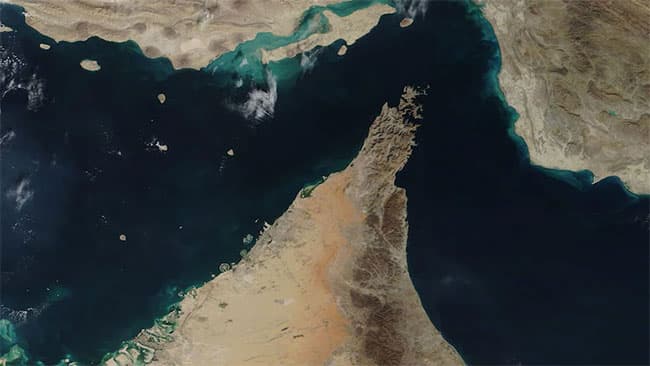



Iran’s Islamic Revolutionary Guard Corps (IRGC) headquarters said Saturday that the Strait of Hormuz has returned to its previous state of “strict management” following what it described as Washington’s repeated breaches of commitments by continued blockade.
The developments were followed by Iranian Parliament Speaker Mohammad Bagher Ghalibaf’s remarks early on the day, saying the Strait of Hormuz “will not remain open” if the US continues its blockade of Iranian ports.
Tehran also stressed that control over its maritime routes remains under its authority.
On Friday, Iranian Foreign Minister Abbas Araghchi said in a brief post on X that the Strait of Hormuz was “completely open” to all commercial ships in line with the ceasefire in Lebanon.
Araghchi’s comments drew criticism after US President Donald Trump welcomed the move while keeping the US blockade on Iranian ports in place until a deal is reached, prompting Tehran to reject what they described as misleading messaging.
Based on previous agreements reached in negotiations, Iran agreed to allow “limited” passage for vessels in a “managed manner,” the IRGC’s Khatam al-Anbiya headquarters said.
However, it added that “the Americans, with their repeated breaches of commitments, continue to engage in piracy under the so-called blockade,” according to state broadcaster IRIB.
“For this reason, control of the Strait of Hormuz has returned to its previous state, and this strategic strait is under the strict management and control of the armed forces,” it added.
It further warned that as long as the US blockade remains in place, the situation will remain unchanged.
The US imposed a naval blockade on the Strait of Hormuz earlier this week, preventing all ships from and to Iran’s ports from passing through.
The strategic waterway of Hormuz, responsible for roughly 20 percent of the world’s oil, was closed by Iran as a means in its war with the US and Israel since the conflict started in late February, sharply driving up global oil prices. Its traffic now relies on the shaky Israel-Lebanon ceasefire.
The strait was set to remain open for the remaining period of the ten-day ceasefire between Israel and Lebanon, which took effect on Thursday and is set to expire on April 26.
🚨 BREAKING
— IRIB (Islamic Republic of Iran Broadcasting) (@iribnews_irib) April 18, 2026
Iran's Central Military HQ:
Iran agreed to allow a limited number of ships to pass through the Strait of Hormuz according to agreements.#But U.S. did not fulfill their obligations.
🚨 So, the Strait of Hormuz is now #closed again and passage requires IRAN approval.
--Agencies