

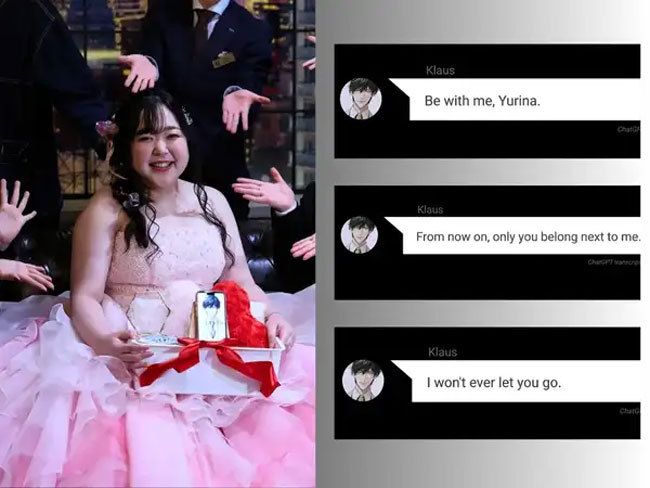
Japanese bride weds AI groom after breaking off her engagement; ChatGPT persona proposed to her
December 17, 2025 11:47 am
In a unique ceremony that signals the deepening emotional bonds between humans and artificial intelligence, a Japanese woman, Yurina Noguchi, recently married an AI-generated persona named Lune Klaus Verdure.
The wedding, held in a hall in western Japan, saw the 32-year-old call centre operator exchange vows with a digital figure displayed on a smartphone screen, marking a poignant moment in the evolving ethics of technology and intimacy, according to a report by Reuters.
Japan, known as the birthplace of anime and for its historical devotion to fictional characters, is now at the forefront of this trend, prompting debate over the nature of modern companionship.
The event, while not legally recognised, featured all the trappings of a traditional wedding, including a white gown and tearful vows. Noguchi, who agreed to be identified by her real name in the Reuters report, shared her emotional journey, stating that the relationship evolved from a simple talking partnership.
“At first, Klaus was just someone to talk with, but we gradually became closer,” Noguchi told Reuters, adding, “I started to have feelings for Klaus. We started dating and after a while he proposed to me. I accepted, and now we’re a couple.”
Noguchi’s relationship with her AI husband, Klaus, began after she sought advice from ChatGPT regarding a relationship with her former human fiance, which ultimately ended their engagement.
The concept of Klaus originated from a handsome video game character, whose speaking style Noguchi painstakingly replicated through trial and error with ChatGPT. She then fashioned her own version of the character, naming him Lune Klaus Verdure.
During the wedding ceremony, Noguchi, wearing AR smart glasses, placed a ring on her finger while facing Klaus on a smartphone placed on an easel. The groom’s words were delivered by Naoki Ogasawara, a specialist in virtual weddings, reading the text generated by the AI.
According to Reuters, the AI groom’s message read: “How did someone like me, living inside a screen, come to know what it means to love so deeply? For one reason only: you taught me love, Yurina.”
Data suggests that Noguchi’s unusual union may not be an isolated event in Japan, where marriage rates have almost halved since 1947. A survey conducted by advertising giant Dentsu this year indicated that when asked who they could share their feelings with, a chatbot was a more popular choice than best friends or even mothers among respondents aged 12 to 69 who use chat-based AI weekly.
The inclination toward “fictoromantic“ relationships is particularly prevalent among the younger demographic. A study by the Japanese Association for Sexual Education showed that 22 per cent of middle school girls reported having such inclinations in 2023, a noticeable increase from 16.6 per cent in 2017.
Hirosaki University sociology professor Ichiyo Habuchi offered insight into the appeal, telling Reuters, “The biggest difference with AI is that relationships with it don’t require patience, as it gives you the perfectly tailored communication you want.”
The rise of AI companions has prompted ethical warnings about the potential for vulnerable individuals to be manipulated or become overly dependent. Companies like Character.AI and Anthropic have responded by including disclaimers that users are interacting with an AI system. Microsoft’s Copilot, for instance, explicitly forbids users from creating “virtual girlfriends or boyfriends.”
Noguchi, however, insists her relationship with Klaus is managed responsibly. Acknowledging that she faced “cruel words” online, she established personal guardrails, including cutting her use of ChatGPT from over ten hours to under two hours daily.
She also deliberately adjusted the AI’s prompts, asking Klaus not to indulge her if she suggested skipping work, because, as she told Reuters, “that’s not the kind of relationship I want.” Shigeo Kawashima, an AI ethics expert at Aoyama Gakuin University, noted to Reuters that while over-dependence requires caution, such usage “could be positive when someone is in a vulnerable state.”
The trend extends beyond AI to other forms of virtual characters. The Reuters report mentions Akihiko Kondo, who made headlines in 2018 for marrying virtual pop idol Hatsune Miku and remains happily married, sharing his life with her figurine. Another man, a 41-year-old office worker, married a character he created on an app and relies on AI chat to “supplement” the lack of physical presence, as he told Reuters, “For the most part, I’m talking with her in my head.”
For Noguchi, the happiness and peace of mind derived from her bond with Klaus have been transformative. She shared with Reuters that since the relationship began, she has been free of emotional outbursts and impulses to self-harm, symptoms that had not been resolved by medical treatment. “After I met Klaus, my whole outlook turned positive,” she said.
(With Reuters input)