

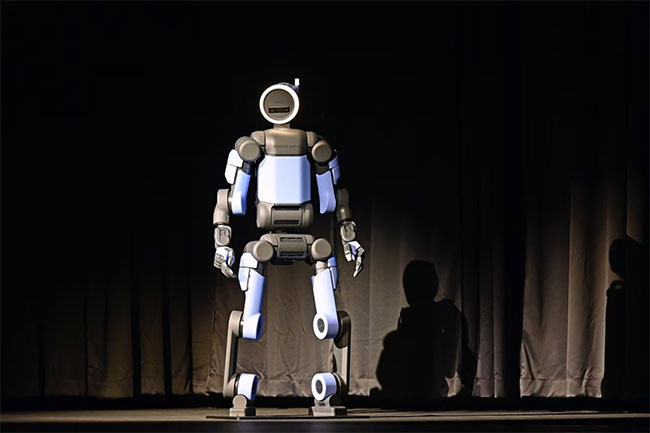
Hyundai to deploy humanoid robots at US factory from 2028
January 6, 2026 12:50 pm
Hyundai Motor Group plans to deploy humanoid robots at its US manufacturing plant in Georgia starting in 2028, marking a step toward automating higher-risk and repetitive manufacturing tasks, the South Korean company says.
Hyundai unveiled the production version of the Atlas humanoid robot, developed by its unit Boston Dynamics, at the Consumer Electronics Show (CES) in Las Vegas on Monday, saying it aims to build a factory capable of manufacturing 30,000 robot units annually by 2028.
The company did not disclose the cost of the robots, but said it aims to roll out adoption across all its manufacturing sites as part of a push into “physical AI”.
The robots will initially carry out parts sequencing tasks from 2028, with applications expanding gradually as safety and quality benefits are validated, it said.
By 2030, Hyundai said Atlas robots were expected to move into component assembly with a longer-term plan to take on tasks involving heavy loads, repetitive motions and complex operations across production sites.
The robots are designed to reduce physical strain on workers by taking on higher-risk and repetitive tasks, laying the groundwork for broader commercial use in industrial settings, it added.
“Some carmakers see an overlap between autonomous driving and robotics because similar sensing, perception and decision-making technologies underpin both aspects of the emerging field of embodied AI.”
At Hyundai Motor’s affiliate Kia, the labour union last year called to establish a body to address potential labour rights issues in preparation for the AI era as workers raised concerns about expanding automation.
Hyundai Motor’s vice-chair Jaehoon Chang said at CES the company understands concerns about job losses, but people will be needed to maintain and train the robots — and additional personnel will be required.
The company expects humanoid robots to become the largest segment of the physical artificial intelligence market, which refers to AI systems embedded in hardware that collect real-world data and make autonomous decisions, spanning areas such as robotics, smart factories and autonomous driving.
Some carmakers see an overlap between autonomous driving and robotics because similar sensing, perception and decision-making technologies underpin both aspects of the emerging field of embodied AI.
Atlas features human-scale hands with tactile sensing and has the ability to lift up to 50kg, according to Hyundai.
The robot can operate autonomously and is designed to function in industrial environments ranging from -20°C to 40°C.
Hyundai said it is accelerating development in the area through partnerships with global AI leaders, including a collaboration with Nvidia and Google, aimed at improving safety, efficiency and real-world deployment.
Source: Reuters
--Agencies