
Speaker rejects motion to appoint select committee on Judicial Service Commission
January 9, 2026 11:49 am
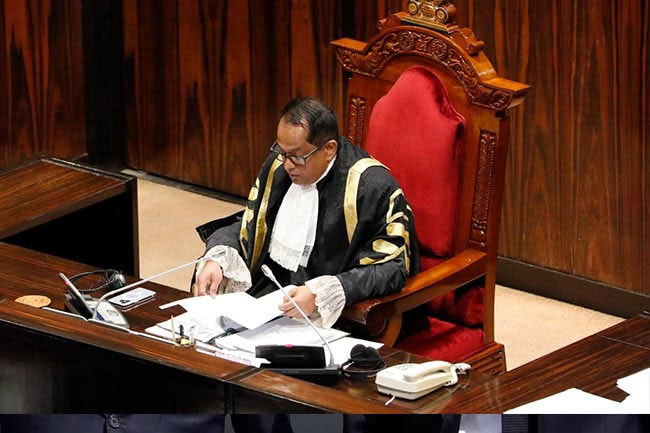
The Speaker of the Parliament, Dr. Jagath Wickramaratne, has declared that a motion submitted by 31 Members of Parliament on 21 November 2025, proposing the appointment of a parliamentary select committee to oversee the Judicial Service Commission (JSC), is out of order and unconstitutional.
The motion, spearheaded by Leader of the Opposition Sajith Premadasa and other opposition MPs, sought to investigate the JSC’s authority over appointments, promotions, transfers, dismissals, and disciplinary control of judicial officers. It also aimed to recommend constitutional and statutory amendments, administrative guidelines, and appeal mechanisms to address alleged irregularities.
In a detailed ruling at today’s parliamentary session, Speaker Wickramaratne emphasized that the JSC functions as an integral part of the judiciary and exercises the judicial power of the people, as outlined in Articles 111D, 111H, 111K, and 111L of the Constitution. He stressed that the JSC is independent of the executive and legislative branches, and parliamentary oversight of its decisions would violate the doctrine of separation of powers.
“The function and purpose of the Judicial Service Commission embodies the exercise of the people’s judicial power and therefore enjoys constitutional protection of judicial independence,” the Speaker stated.
He further clarified that while Parliament holds the public purse and has fiduciary responsibilities, this does not grant hierarchical authority over judicial functions.
Citing both Sri Lankan and international jurisprudence, including Supreme Court cases, the Speaker reinforced that judicial independence must not be subjected to political scrutiny or legislative interference.
The ruling underscores that any parliamentary action encroaching upon the JSC’s authority would constitute a violation of the Constitution and a derogation of the judicial power of the people.
Speaker Wickramaratne expressed that this decision will serve as a landmark in Sri Lankan parliamentary history, reinforcing the country’s commitment to the separation of powers and the independence of the judiciary.