
Over 124,000 arrests made under ‘A Nation United’ programme since October 2025
March 18, 2026 08:52 pm
President Anura Kumara Dissanayake stated that the quantitative increase in arrests of drugs and drug-related individuals is a positive development, while emphasising that ensuring public confidence, as well as that of operational teams, in the destruction of seized drug stocks is a priority.
He instructed the relevant authorities to expedite necessary legal amendments, and further directed that discussions be held with the appointed Council to accelerate legislative drafting to avoid delays in implementing these measures, according to the President’s Media Division (PMD).
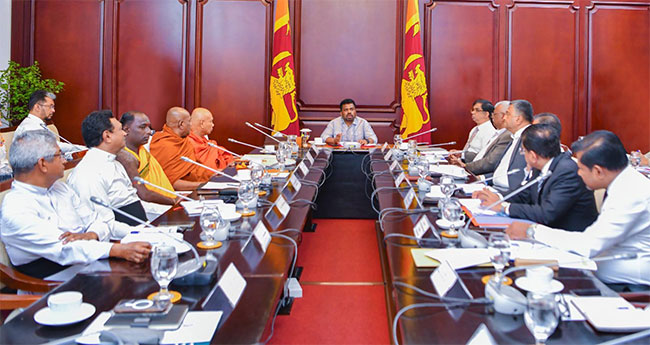
The President made these remarks while attending a meeting of the ‘A Nation United’ National Steering Council held this morning (18) at the Presidential Secretariat.
He stressed that, despite various social and economic challenges faced by the country, the Government’s programme to eradicate the drug menace must not be hindered under any circumstances.
President Dissanayake highlighted the need to continue implementing programmes, such as dismantling drug supply and distribution networks and strengthening rehabilitation and judicial processes, efficiently and without interruption, while maintaining continuous dialogue with society to ensure the successful completion of this national programme.
Extensive discussions were held on the progress achieved and future plans of the ‘A Nation United’ national programme, launched on October 30, 2025. It was revealed that this initiative has become a key factor in strengthening public confidence in the current Government. Relevant authorities presented statistical data showing a significant increase in arrests related to drugs and drug-related offences.
Since the launch of the programme on 30 October 2025, a total of 124,412 arrests have been made. Seizures include 4,520 kg of cannabis, 1,066 kg and 352 g of heroin, 558,300 illegal cigarettes, 1,930 kg of crystal methamphetamine (“ice”), 270 kg of cocaine, and 983,143 narcotic pills. The cocaine haul was also identified as the largest and most valuable in history, the statement said.
The programme has also led to a significant increase in drug-related information received via the police ‘1818’ hotline, with ongoing review of operational progress.
It was noted that those arrested include individuals from various segments of society, including 1,772 boys and 81 girls, PMD said.
The statement further stated that among those arrested, 196 are suspects linked to illegal assets, 2,268 are under detention orders, and 1,840 individuals have been referred for rehabilitation.
Officials pointed out that delays in referring individuals for rehabilitation are due to existing legal shortcomings; however, the appointed Council is currently discussing these issues and planning future actions.
Limitations in existing rehabilitation legislation, including barriers to properly reintegrating addicts into society and inadequate capacity at rehabilitation centres, were also discussed.
The President instructed that the law be amended promptly to suit current needs and that proposals be obtained and finalised as soon as possible.
Attention was also drawn to delays in court proceedings caused by the lengthy time taken to analyse seized drug samples and obtain reports, along with proposals submitted to address this issue.
Discussions were also held on strengthening judicial processes, including proposals to establish a dedicated court and legal procedure for drug-related offences, set up provincial-level drug courts, and empower police legal divisions to handle such offences.
The Secretary to the Ministry of Health stated that several programmes have been planned, with the participation of all stakeholders, to rehabilitate and treat drug addicts.
These programmes are being implemented through six key strategies, including enabling access to primary treatment even via outpatient services, increasing referrals to psychiatric clinics, providing residential care, and ensuring community-based rehabilitation and follow-up, PMD said in the statement.
He further noted that separate programmes have been designed for youth, children, and pregnant women affected by drug addiction. A monitoring mechanism has been established, and plans are in place to incorporate support from community empowerment programmes.
Measures to protect schoolchildren from drug abuse, including school-level programmes, raids conducted in school environments, and emerging trends, were also discussed. Awareness programmes within government institutions and their progress were reviewed as well.
The President also highlighted the importance of initiating religious programmes centred around places of worship as part of the national effort to eradicate the drug menace.
It was emphasised that media coverage given to drug-related arrests should also extend to the destruction of seized drugs and programmes aimed at rehabilitating addicts, it added.
Religious leaders, including the Anunayaka of the Sri Lanka Ramanna Maha Nikaya, the Most Venerable Waleboda Gunasiri Anunayake Thero, the Venerable Kuppiyawatte Bodhananda Thero, Reverend Father Dilan Fernando, Reverend Father Jude Bernard Rodrigo, Kurukkal Suresh Sharma and Kurukkal Muthusamy Alagesan, were present.
Also in attendance were Secretary to the President Dr Nandika Sanath Kumanayake, Secretary to the Ministry of Defence (Retired) Air Vice Marshal Sampath Thuyacontha, Secretary to the Ministry of Public Security Ravi Seneviratne, along with other ministry secretaries and heads of relevant institutions, the tri-forces commanders, the Inspector General of Police, and representatives of the security forces.
--PMD--