







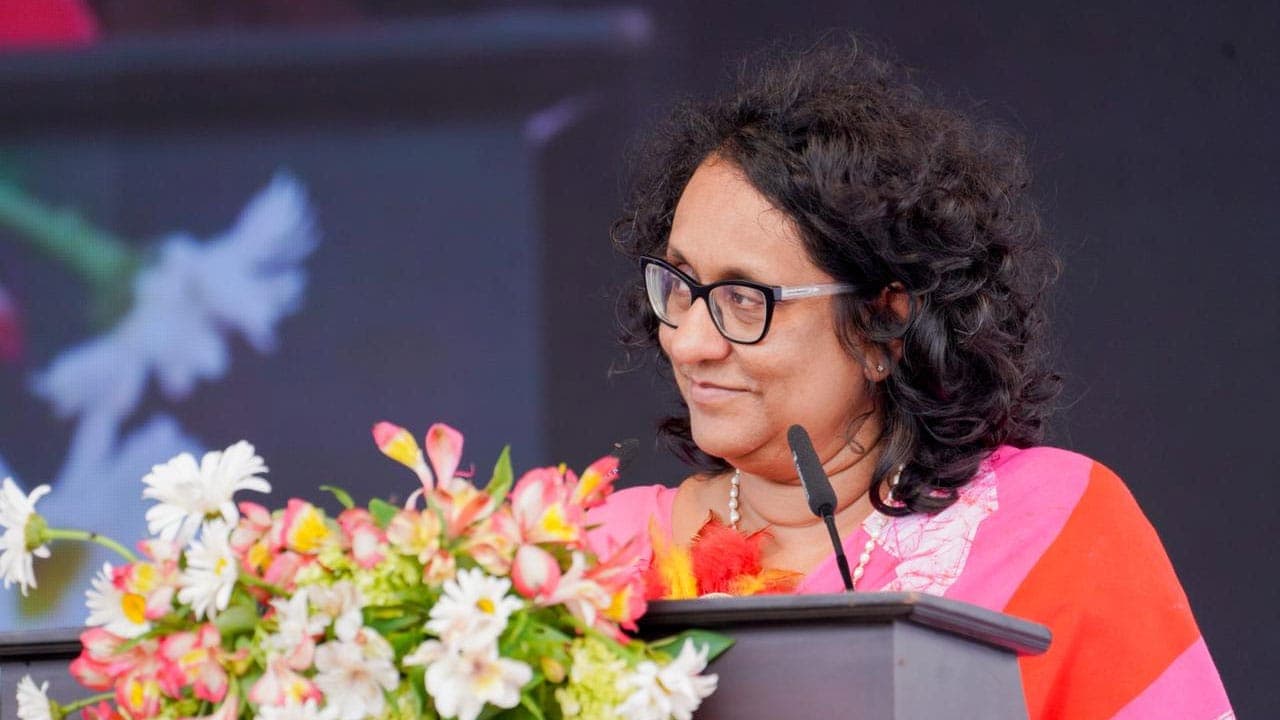


Prime Minister Dr. Harini Amarasuriya emphasised that the benefits of education should not be limited to a particular segment of society, and that a child’s future should be determined not by the economic circumstances or the area in which they live, but by their efforts and the opportunities available to develop their abilities.
The Prime Minister made these remarks while participating as the Chief Guest at the centenary celebration of Kekunagolla National School in Kurunegala.
Stating that a hundred years represents not merely a milestone in a school’s history, but a long journey intertwined with the dreams, aspirations, dedication and achievements of generations, the Prime Minister noted that, throughout the past century, Kekunagolla National School has illuminated the lives of thousands of children and guided them towards a brighter future.
She also paid tribute to the dedication of the pioneers who laid the foundation for this remarkable journey, the service rendered by successive principals and teachers, and the contributions of parents, the PM’s Office said.
The Prime Minister pointed out that education should not be confined to passing examinations. She emphasised that a school’s fundamental responsibility is to nurture citizens equipped with knowledge, creativity, a spirit of brotherhood and humanity.
She further highlighted the importance of guiding children to live together in harmony, respecting one another’s religious and cultural identities, particularly in a diverse area such as Kurunegala, which is home to different ethnic groups and cultures.
The Prime Minister also stated that the new education reforms introduced by the Government are not limited to changing a few subject syllabuses, but constitute a comprehensive programme to modernise the entire education process.
Accordingly, she stated that arrangements have been made to introduce new curricula for Grades 2 and 6 in 2027. She further explained that steps are being taken to strengthen all five key pillars of education subject knowledge, teaching methods, teacher training, physical resources and technological resources, to reduce the disparities in facilities between urban and rural schools.