








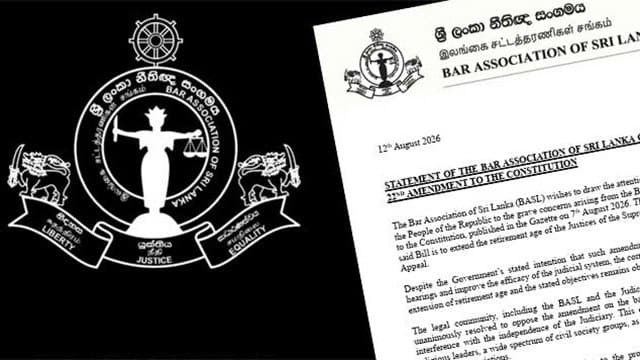



The Bar Association of Sri Lanka (BASL) has strongly opposed the proposed 22nd Amendment to the Constitution, warning that the move to extend the retirement age of Supreme Court and Court of Appeal justices could have serious implications for judicial independence in the country.
The Draft Bill was published in the gazette on August 7, with the government stating that the proposed change is aimed at expediting the hearing of cases and improving the efficiency of the judicial system.
However, the BASL said the connection between extending the retirement age of judges and achieving those objectives remains unclear.
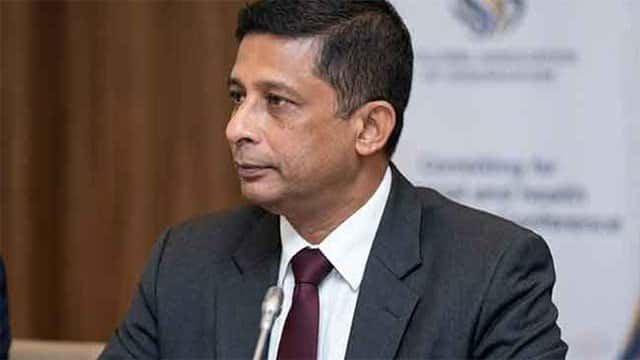
In a statement issued today (12) with the signatures of BASL President Rajeev Amarasuriya and Secretary Nalin De Silva, the Bar Association of Sri Lanka said the legal community, including the BASL and the Judicial Service Association, had resolved to oppose the proposed amendment on the basis that it constitutes direct interference with the independence of the Judiciary.
The association said concerns over the proposal had also been raised by religious leaders, civil society organisations and prominent overseas law and judges' associations.
BASL says referendum is necessary
The BASL in its statement raised several matters on whether the proposed amendment can be passed by a vote in Parliament alone.
The association argued that any change to the retirement age of justices of the superior courts affects the constitutionally protected independence of the Judiciary and therefore requires approval by the people at a referendum.
The BASL pointed to Article 107 of the Constitution, which deals with the retirement age of judges of the superior courts and is contained within Chapter XV, under the heading relating to the independence of the Judiciary.
It also referred to Article 3, which states that sovereignty is vested in the people, and Article 4c, under which judicial power is recognised as part of that sovereignty.
The association further relied on a 2022 Supreme Court determination, SC SD 64-71/2022, in which the court observed that a constitutional amendment affecting the retirement age or period of office of incumbent judges would impinge on judicial independence and violate Article 3, thereby requiring a referendum.
The BASL said this determination makes clear that the proposed amendment is an entrenched provision that cannot be validly enacted without the approval of the people at a referendum.
Concern over Supreme Court challenge
The association also highlighted what it described as a serious constitutional dilemma that could arise if the Bill is placed on Parliament's Order Paper.
Any citizen would then have the right to challenge the constitutionality of the Bill before the Supreme Court, the BASL said.
Such a challenge, it argued, could place Supreme Court judges in an exceptionally sensitive position because the court could be required to determine the legality of an amendment that would extend the tenure of its own members.
The BASL warned that this could lead to an erosion of public confidence in the Judiciary and damage its credibility.
If the government decides to proceed despite the objections, the association urged the Cabinet to submit the Bill directly to a referendum.
According to the BASL, doing so would allow the People to decide the issue while avoiding a situation in which the Supreme Court would have to determine the constitutionality of a measure affecting the tenure of its own judges.
BASL criticises lack of consultation
The Bar Association also criticised the government for what it described as a lack of meaningful consultation with key stakeholders.
The BASL said that, unlike in some other jurisdictions where similar changes to judicial tenure had been preceded by transparent and lengthy consultations, no comparable consultative process had taken place in Sri Lanka.
It warned that the combination of limited consultation and what it described as unusual haste in advancing the proposal could undermine public confidence and establish a dangerous precedent for future governments.
The association said constitutional changes affecting judicial tenure should be approached with the utmost caution and transparency, particularly where there could be a perception that the changes relate to particular individuals.
'Appearance of interference' can damage confidence
Responding to comments from some Ministers and Government MPs questioning why judicial independence had become a central concern, the BASL stressed that public confidence is fundamental to the administration of justice.
It said even the appearance of bias or interference could create doubts about judicial independence and fairness, regardless of whether actual bias exists.
The BASL said the independence, dignity and reputation of the Judiciary must therefore be protected.
It further emphasised that constitutional amendments have consequences that extend beyond any particular government or political regime and could shape the country's constitutional framework and administration of justice for generations.
The association said it considers it a constitutional responsibility to safeguard the independence and integrity of the Judiciary and ensure that these protections are not weakened for present or future generations.
The BASL ultimately called on the government not to proceed with the proposed 22nd Amendment in its present form, stressing that maintaining an independent and credible Judiciary is essential to public confidence, the Rule of Law and Sri Lanka's constitutional governance.
President to meet BASL today
Meanwhile, President Anura Kumara Dissanayake is scheduled to meet representatives of the Bar Association of Sri Lanka (BASL) at 1.00 p.m. today (12) to discuss the government’s proposal to amend the Constitution and increase the retirement age of judges.