











Six petitions have been filed before the Supreme Court challenging the 22nd Amendment to the Constitution, which was presented to Parliament today (18).
The petitions have been filed by several individuals and organizations, including the Bar Association of Sri Lanka (BASL), Samagi Jana Balawegaya (SJB), Sarvajana Balaya and Free Lawyers organization.
Bar Association challenges 22nd Amendment
The first petition was filed by the Bar Association of Sri Lanka, seeking a determination from the Supreme Court that the proposed 22nd Constitutional Amendment Bill is inconsistent with the Constitution.
The petition was filed by BASL Treasurer T.M.S. Pasindu Silva and Assistant Secretary L.I. Wakishta Arachchi, with the Attorney General named as the respondent.
The petitioners argue that the proposed amendment directly affects the sovereignty of the people, which is protected under Article 3 of the Sri Lankan Constitution.
They further claim that several local and international legal organizations have already raised concerns about the proposed legislation.
Among those cited are the Judicial Service Association of Sri Lanka, the Chief Prelates, the Commonwealth Lawyers Association, LAWASIA, the International Association of Judges, UN Special Rapporteur on the Independence of Judges and Lawyers Margaret Satterthwaite, and the French National Bar Council.
Petition raises concerns over judicial independence
The BASL petition also argues that the proposed amendments could conflict with several international principles and instruments relating to judicial independence and fundamental rights.
According to the petition, any amendment to Article 107(5) could have implications for principles contained in international instruments, including the International Covenant on Civil and Political Rights, UN principles on judicial independence, the Universal Charter of the Judge, and the Commonwealth Charter.
The petitioners have requested the Supreme Court to consider the constitutionality of the proposed Bill with all judges of the Court sitting together.
They have also asked the Court to determine that Clauses 2 and 3 of the Bill, if found to directly contravene Article 3 of the Constitution, would require approval by the people at a referendum in addition to parliamentary approval.
SJB and Sarvajana Balaya also challenge Bill
The Samagi Jana Balawegaya has separately filed a petition challenging the proposed 22nd Constitutional Amendment.
The party has argued that any constitutional amendment must be carefully assessed in terms of its potential impact on Sri Lanka’s democratic structure, separation of powers and fundamental rights.
The Sarvajana Balaya has also approached the Supreme Court challenging the proposed amendment.
Former Minister of Justice and Constitutional Affairs Professor G.L. Peiris has filed a separate petition, requesting the Supreme Court to rule that the proposed constitutional amendment requires not only a two-thirds majority in Parliament, but also approval through a referendum.
The Free Lawyers organization has also filed a petition challenging the proposed amendment.
Presentation of Bill in Parliament
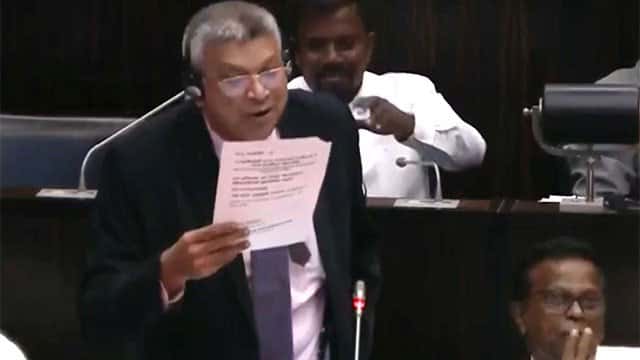
The 22nd Constitutional Amendment Bill and the Judicature (Amendment) Bill were presented to Parliament today by Minister of Justice and National Integration Harshana Nanayakkara.
The government gazetted the proposed 22nd Constitutional Amendment Bill on August 7, despite the objections.
Under parliamentary procedure, a Bill must be presented for its first reading one week after the issuance of its Gazette notification, following which a one-week period is available for petitions challenging the Bill before the Supreme Court.
The Supreme Court is required to communicate its determination to the Speaker within three to 21 days after considering such petitions.
If enacted, the 22nd Amendment to the Constitution will increase the retirement age of Supreme Court judges from 65 to 67 years and that of Court of Appeal judges from 63 to 65 years.
Meanwhile, the Judicature (Amendment) Bill proposes to raise the retirement age of judges serving in the High Courts, District Courts and Magistrates’ Courts to 62 years.