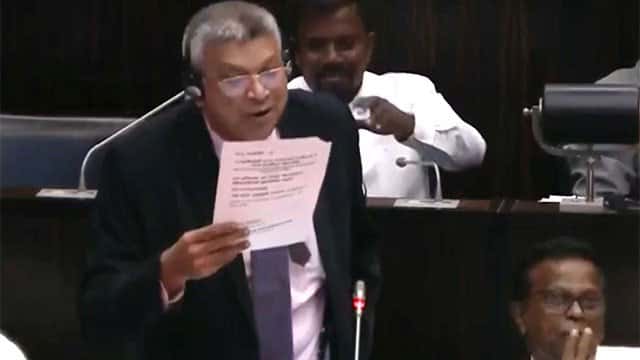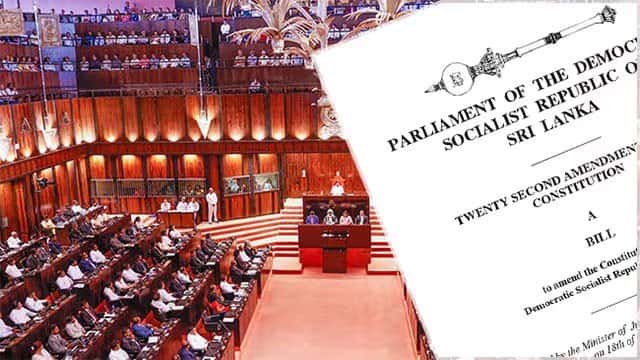












Parliament is scheduled to begin the Second Reading debate on the 22nd Amendment to the Constitution Bill and the Judicature (Amendment) Bill today (24), with the debate continuing tomorrow (25), ahead of votes on the two legislation.
According to the parliamentary programme, time has been allocated from 11.30 a.m. to 7.00 p.m. on both days for the Second Reading debate.
The debate was scheduled after the Supreme Court’s determination on challenges filed against the two Bills. Speaker of House Dr. Jagath Wickramaratne presented the Supreme Court’s determination to Parliament on September 22.
The Supreme Court determined that the provisions of the 22nd Amendment Bill do not require approval by the people at a referendum under Article 83 of the Constitution. The Bill can therefore proceed with the required special majority in Parliament.
The Court also directed changes to Clause 2 of the Bill. These include a change to the wording concerning the completion of the age of 67 and the addition of a proviso stating that the proposed six-year term limit for the Chief Justice would not apply to the person holding that office when the Act comes into operation.
The Supreme Court further determined that the Judicature (Amendment) Bill is not inconsistent with the Constitution and can be passed by a simple majority in Parliament.
Bills presented in August
The two Bills were presented to Parliament on August 18 by Minister of Justice and National Integration Harshana Nanayakkara.
The 22nd Amendment proposes changes to the retirement ages of judges of the superior courts. Under the proposal, the mandatory retirement age for Supreme Court judges would increase from 65 to 67, while the retirement age for Court of Appeal judges would increase from 63 to 65.
The Bill also proposes that the Chief Justice would retire upon reaching 67 or completing six years in office, whichever occurs first, subject to the amendment ordered by the Supreme Court concerning the incumbent Chief Justice.
The accompanying Judicature (Amendment) Bill concerns judges serving in the lower courts and proposes increasing the retirement age of judges of the High Courts, District Courts and Magistrates’ Courts to 62.
The government has said the proposed changes are intended to strengthen the judicial system, improve efficiency and address delays and the backlog of cases. The Cabinet of Ministers had earlier approved drafting of the legislation with the stated objective of strengthening judicial independence and facilitating the efficient disposal of pending cases.
Supreme Court challenges
The Bills faced legal challenges after being presented to Parliament. More than 65 petitions were filed before the Supreme Court challenging the legislation. The petitions were taken up before a five-member bench headed by the Chief Justice on September 1, and the hearing concluded on September 2.
The five-member bench comprised Chief Justice Preethi Padman Surasena and Justices Achala Wengappuli, Arjuna Obeyesekere, Sampath B. Abeykoon and K.M. Gihan Kulatunga.
Following the hearings, the Supreme Court communicated its determination to the Speaker, who subsequently announced it in Parliament on September 22.
Concerns raised over the proposals
The proposed changes have generated debate among political parties and sections of the legal profession.
The Bar Association of Sri Lanka (BASL) appeared before the Supreme Court during the proceedings. Following the Court’s determination, the BASL said the Court’s constitutional determination should be distinguished from the separate question of whether Parliament should enact the proposed amendment.
The BASL has raised concerns about the potential implications of extending judicial tenure and has called on political parties to allow MPs to speak and vote according to their conscience.
Opposition parties have also announced demonstrations against the proposed amendment. Opposition MPs and representatives have raised concerns about the possible effect of the legislation on judicial independence and the constitutional system.
Meanwhile, Cabinet Spokesperson and Minister Dr. Nalinda Jayatissa has said the government followed the constitutional procedures required to proceed with the amendment. He has also said those who disagree with the Supreme Court’s determination remain free to express their views in Parliament and conduct demonstrations, while stressing that the question of whether a referendum is constitutionally required is determined through the constitutional process.
Committee approval
The Sectoral Oversight Committee on Public Administration, Justice and Civil Security has also approved the two Bills.
The committee met under the chairmanship of Parliamentarian Najith Indika, with the Attorney General providing an explanation to the committee regarding the proposed legislation, according to Parliament’s Communications Department.
The Bills now move through the parliamentary debate scheduled for today and tomorrow.
The vote on the 22nd Amendment is scheduled for 7.00 p.m. tomorrow, following the conclusion of the two-day debate.