
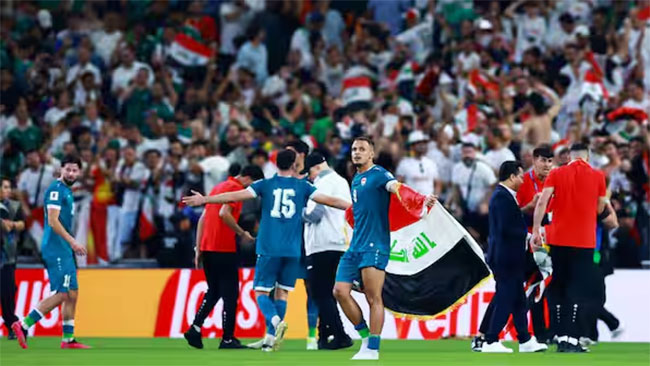
Iran’s World Cup participation faces fresh threat
April 13, 2026 05:18 pm
Iran’s participation in the upcoming FIFA World Cup is facing fresh uncertainty, as escalating tensions with the United States, one of the host nations, threaten to spill into the sport.
A fragile ceasefire between the two countries is now under strain, after Washington announced plans for a naval blockade starting on Monday (Apr 13) targeting Iranian ports and traffic linked to the vital Strait of Hormuz.
The developments have raised questions over whether Iran’s national team will be able to play matches on American soil.
The 2026 World Cup, set to be hosted across the US, Canada and Mexico, will be the largest in history, featuring 48 teams. Iran is scheduled to play group matches in the US against New Zealand, Belgium and Egypt.
It is the first time a host nation is at war with one of its participants in the lead-up to the competition.
PRIDE AND CONNECTION TO HOME
For some Iranian-Americans, football is a link to home.
Amir S, who moved to the US at a young age, said the sport helps him stay connected to his roots and family in Iran.
“You know, sports just sort of brings people together,” he told CNA.
Amir has spent hundreds of dollars securing 12 tickets to watch Iran’s national team, known as Team Melli, at the tournament, which begins in June.
For supporters like him, the World Cup represents a rare opportunity to celebrate national pride.
But whether Iran will take to the pitch in the US remains unclear.
CONFLICTING SIGNALS FROM LEADERS
In March, US President Donald Trump wrote on social media that the team was welcome, but added he did not believe it was “appropriate” for them to be there, citing concerns for their lives and safety.
Iran’s sports minister said in response that “considering the US assassinated their leader, under no circumstances could they participate in the World Cup”, referring to the killing of Supreme Leader Ayatollah Ali Khamenei in US-Israeli strikes on Feb 28.
Team Melli pushed back on social media, saying “no one can exclude them from playing”, while the Iranian Football Federation indicated it was exploring the possibility of moving matches to another host country, such as Mexico.
However, FIFA president Gianni Infantino later said Iran would play in the US, following discussions with the team and coach.
PRESSURE AND GLOBAL IMPLICATIONS
Sports diplomacy experts say withdrawing from the tournament at this stage would come at a high cost.
Lindsay Krasnoff, clinical assistant professor at New York University’s Preston Robert Tisch Institute for Global Sport, noted that teams face penalties for pulling out after qualification deadlines.
“It would make the Iranian Football Association and its team subject to disciplinary measures within FIFA … whether it is potential non-qualification for future tournaments or fines,” she added.
Allowing Iran’s matches to be relocated could also set a precedent.
“There could be, in the future, other requests for teams to be moved based on geopolitical events or other issues,” Krasnoff said.
If Iran does not participate, its spot could go to another Asian team, with the United Arab Emirates seen as one of the frontrunners.
A DIVIDED DIASPORA
Beyond soccer, the situation is also exposing divisions within the Iranian diaspora in the US.
Some supporters want Team Melli to succeed. Others, citing historical factors, including the state’s influence over the sport, see it as a symbol of an oppressive regime.
“It is political, whether we like it or not,” said Marjan Kamyab, who moved to the US a decade ago.
She noted that following the 1979 Iranian Revolution, the state has exerted significant control over football, including restricting women from attending matches.
The ban has been partially eased in recent years, but limited ticket allocations, segregated seating and inconsistent enforcement mean many women are still unable to attend matches freely.
“The diaspora here are very, very anti-regime and anti-Team Melli right now. They view Team Melli as the regime’s team,” she said.
“So, they’re going to go to the stadiums and do the same thing they did in Qatar. They’re going to boo them and they’re going to protest.”
At the 2022 World Cup in Qatar, some Iranian fans protested in and around stadiums, holding banners with slogans such as “women, life, freedom” – a rallying cry linked to nationwide protests sparked by the death of 22-year-old Mahsa Amini, a Kurdish woman detained by Iran’s morality police for allegedly violating the country’s hijab laws.
For Kamyab, events in Iran have overshadowed the sport.
She added: “Thinking about football as a sport is like, as my husband says, it’s like thinking about Mona Lisa, while the Louvre is burning.”
Source: CNA
--Agencies