
Korea partners with UNDP to tackle Sri Lanka’s waste management challenges
January 30, 2026 02:48 pm
The Government of the Republic of Korea has partnered with the United Nations Development Programme (UNDP) in Sri Lanka to support Sri Lanka in addressing its growing waste management challenges, with funding of USD 4.7 million for a new initiative.
The project, titled “Scale-up and Sustain the Low-Carbon Municipal Solid Waste Management and Resource Recovery in Sri Lanka,” is funded by the Ministry of Climate, Energy and Environment of the Republic of Korea through the Korea Environmental Industry and Technology Institute (KEITI).
It will be implemented by UNDP Sri Lanka in collaboration with the Ministry of Public Administration, Provincial Councils and Local Government.
According to a statement issued by UNDP, the initiative aims to promote sustainable, low-carbon and locally appropriate solutions to transform municipal solid waste management systems in two selected local authorities within the Central and Sabaragamuwa provinces.
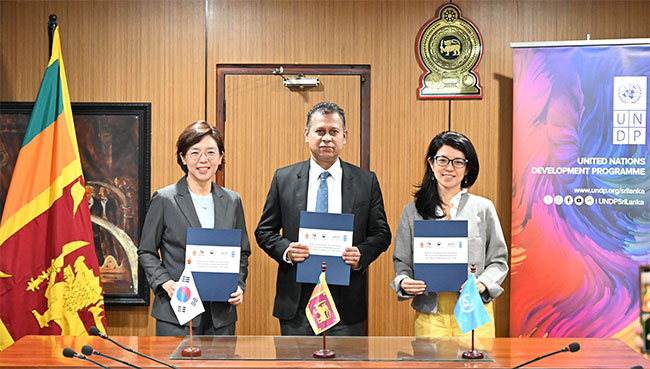
A symbolic signing ceremony was held today with the participation of S. Aloka Bandara, Secretary to the Ministry of Public Administration, Provincial Councils and Local Government; Miyon Lee, Ambassador of the Republic of Korea to Sri Lanka; and Azusa Kubota, Resident Representative of UNDP Sri Lanka, along with representatives of partner institutions.
Sri Lanka currently generates more than 10,000 metric tons of municipal solid waste per day. However, only about half of this waste is collected, while only a small fraction is properly treated.
The remainder is often dumped or burned in open sites, creating serious environmental, public health and social risks.
Previous waste management interventions have faced persistent challenges, including unsuitable technologies, financial and institutional limitations, and inadequate community participation. The waste sector has also been severely affected by climate change and natural disasters, as observed during the recent Cyclone Ditwah and floods, which overwhelmed the capacities of local authorities and exposed vulnerable communities engaged in waste-related activities.
Emphasizing the importance of advancing sustainable waste management, Secretary S. Aloka Bandara, Ministry of Public Administration, Provincial Councils and Local Government stated that strengthening municipal solid waste management is a key national priority. He noted that the project represents a major step forward in translating policy into action by building environmentally responsible, locally grounded systems capable of delivering long-term benefits for communities, public health and environmental protection, the statement stated.
The project seeks to overcome existing barriers by strengthening decentralized waste management systems within local authority jurisdictions, thereby avoiding the logistical, social and financial challenges associated with transporting waste across administrative boundaries.
UNDP Sri Lanka will lead the implementation in close coordination with provincial and local government institutions, the Ministry of Public Administration, Provincial Councils and Local Government, local authorities, private sector partners and Korean technical agencies.
Addressing Korea’s commitment to supporting Sri Lanka’s sustainable development and climate initiatives, Ambassador of the Republic of Korea Miyon Lee welcomed the launch of the project and expressed confidence in its successful implementation. She reaffirmed Korea’s willingness to share its advanced technology, expertise and resources to help establish an effective and sustainable solid waste management system across four provinces.
Highlighting the urgency of the initiative, UNDP Sri Lanka Resident Representative Azusa Kubota stated that the project comes at a critical moment for the country. She noted that, with KEITI’s support, the programme will introduce environmentally sound, climate-resilient and disaster-proofed solutions that are also economically viable and socially inclusive, while creating green jobs and strengthening institutional resilience.
Environment Adviser Rhyunmin Park of the UNDP Bangkok Regional Hub also expressed his commitment to collaborating through the project to support the foundation of sustainable waste management systems across the Asia-Pacific region.
Under the initiative, strategic waste management plans will be developed in four provinces namely the Northwestern, Central, Sabaragamuwa and Southern. In addition, demonstration projects will be implemented at the Gampola and Balangoda Urban Councils, the statement said.
In Gampola, an anaerobic digestion plant and pyrolysis technology will be introduced, with an estimated reduction of 168,630 metric tons of carbon dioxide equivalent emissions over a ten-year period. In Balangoda, vermicomposting and pyrolysis technologies will be applied, with an expected reduction of 100,740 metric tons of emissions.
Further underscoring Korea’s support, Eunhae Jung, Director General of the International Cooperation Bureau of the Ministry of Climate, Energy and Environment of the Republic of Korea, stated that the project reflects Korea’s commitment to advancing global climate action through practical and scalable solutions. She noted that beyond emission reductions, the initiative empowers local governments and communities to take leadership in sustainable waste management and by sharing this expertise and innovative technologies, they hope the progress made here will serve as a model for other countries.
Beyond infrastructure development, the project will promote behavioural change and innovation by encouraging waste minimisation through ‘refuse, reduce and reuse’ practices, improving waste segregation at source, and piloting smart waste collection systems using digital applications. Capacity-building and knowledge-sharing will play a central role to ensure that the interventions are replicable and scalable.
The programme is structured around four core components: strengthening policy and institutional frameworks; demonstrating best-fit waste management technologies; developing green financing models and public-private partnerships; and establishing effective monitoring and evaluation systems. Gender-responsive approaches will be integrated throughout the project to ensure women’s meaningful participation and to address the disproportionate burdens they face in waste-related labour, it added.
The initiative marks a significant contribution towards achieving Sri Lanka’s climate commitments under the Paris Agreement, including its waste sector Nationally Determined Contributions.
By reducing emissions, improving resource recovery and promoting inclusive green growth, the project is expected to support progress toward multiple Sustainable Development Goals, including good health and well-being, sustainable cities and communities, climate action, and decent work and economic growth.