
South Korea’s ex-President Yoon sentenced to life in prison for insurrection
February 19, 2026 01:06 pm
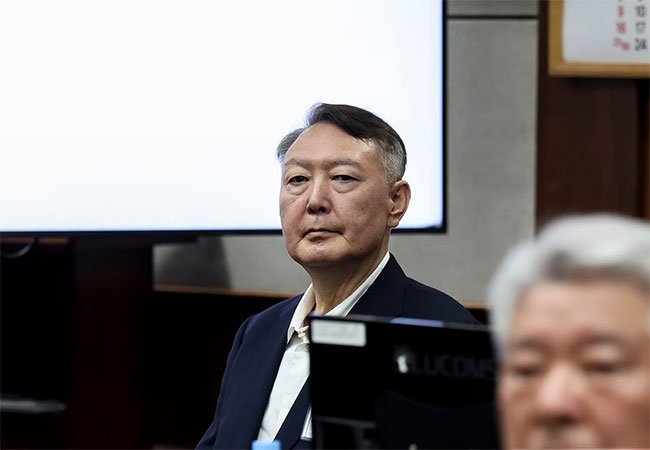
A South Korean court ordered life in jail on Thursday for former President Yoon Suk Yeol, after holding him guilty on charges of abuse of authority and masterminding an insurrection, stemming from his December 2024 attempt to impose martial law.
Prosecutors had sought the death penalty in the case, closely watched in a deeply divided country. It is the most consequential yet for the ousted leader, whose bid triggered a national political crisis and tested democratic resilience.
In January, prosecutors had said Yoon’s “unconstitutional and illegal emergency martial law undermined the function of the National Assembly and the Election Commission ... actually destroying the liberal democratic constitutional order.”
Masterminding an insurrection carries a maximum sentence of the death penalty or life imprisonment under South Korean law.
South Korea last handed down a death sentence in 2016, but has not executed anyone since 1997.
There was a strong police presence at the Seoul Central District Court, which is trying the case, with police buses forming a security cordon around the building.
The court will also rule on charges that Yoon abused his authority by ordering troops to storm parliament to drag his opponents out and jail them, as well as dispatching soldiers and police to block, inspect, and control access to facilities such as the opposition party building.
Yoon, 65, has denied the charges. The conservative former career prosecutor argued he had presidential authority to declare martial law and that his action was aimed at sounding the alarm over opposition parties’ obstruction of government.
SEOUL DETENTION CENTRE
The ousted former leader, who has been detained at the Seoul Detention Centre, is likely to remain there regardless of the ruling. If found guilty, he is expected to appeal the ruling and can again challenge any appellate court decision at the Supreme Court.
Judicial guidelines say the first trial should conclude within six months and the entire process, including appeals, in two years, but trials often stretch beyond that.
If the Seoul district court clears him on Thursday, his legal woes are far from over.
Yoon, who faces eight trial proceedings, was given a five-year jail sentence in January in a separate trial on charges including obstructing attempts by authorities to arrest him following his martial law declaration. He has appealed that ruling.
While Yoon’s bid to impose martial law lasted only about six hours before it was met by large street protests and voted down by parliament, it sent shockwaves through South Korea, which is Asia’s fourth-largest economy, a key U.S. security ally, and long considered one of the world’s most resilient democracies.
In a post on X, President Lee Jae Myung, a liberal who won the presidency in a snap election in June after Yoon’s removal, commended the actions of the Korean people to thwart the attempt to bring in martial law.
“It was possible because it was the Republic of Korea”, Lee said, using South Korea’s official name, adding the Korean people would serve as an example for human history.
His post was attached to a newspaper story about how some academics had recommended that the Korean public be nominated for a Nobel Peace Prize for facing off against troops and police to oppose martial law without violence.
Source: Reuters
--Agencies