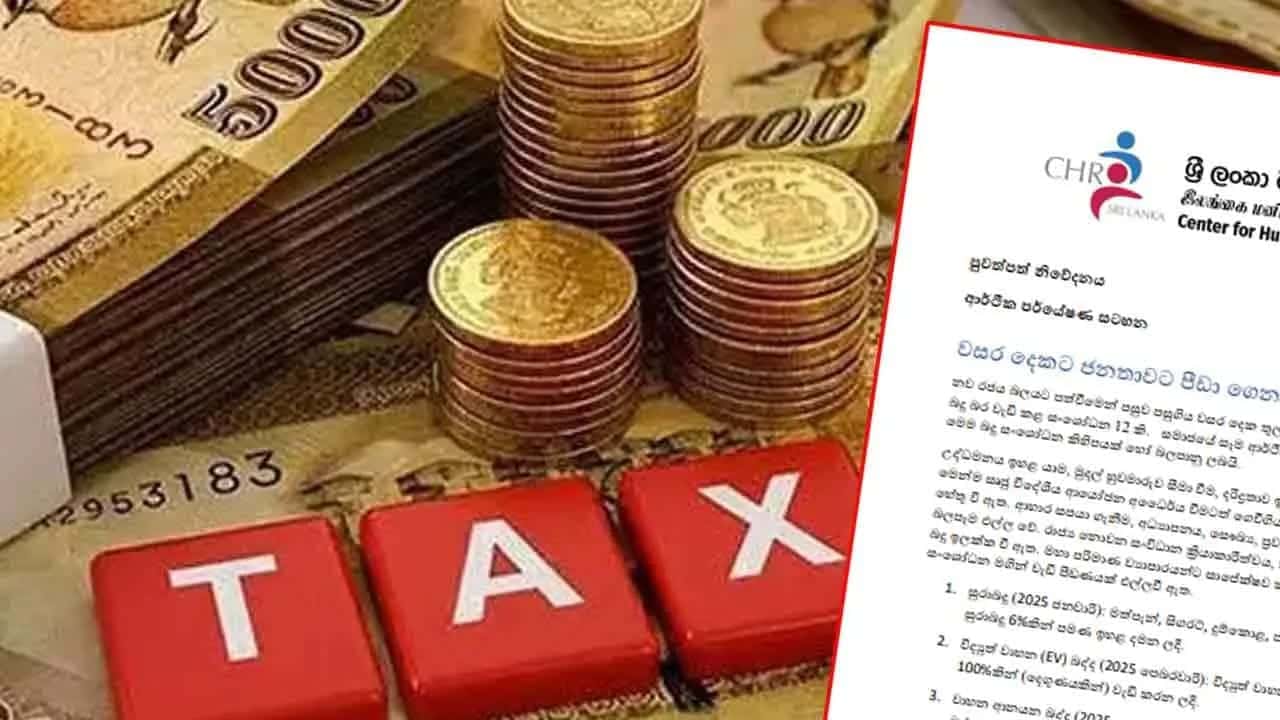







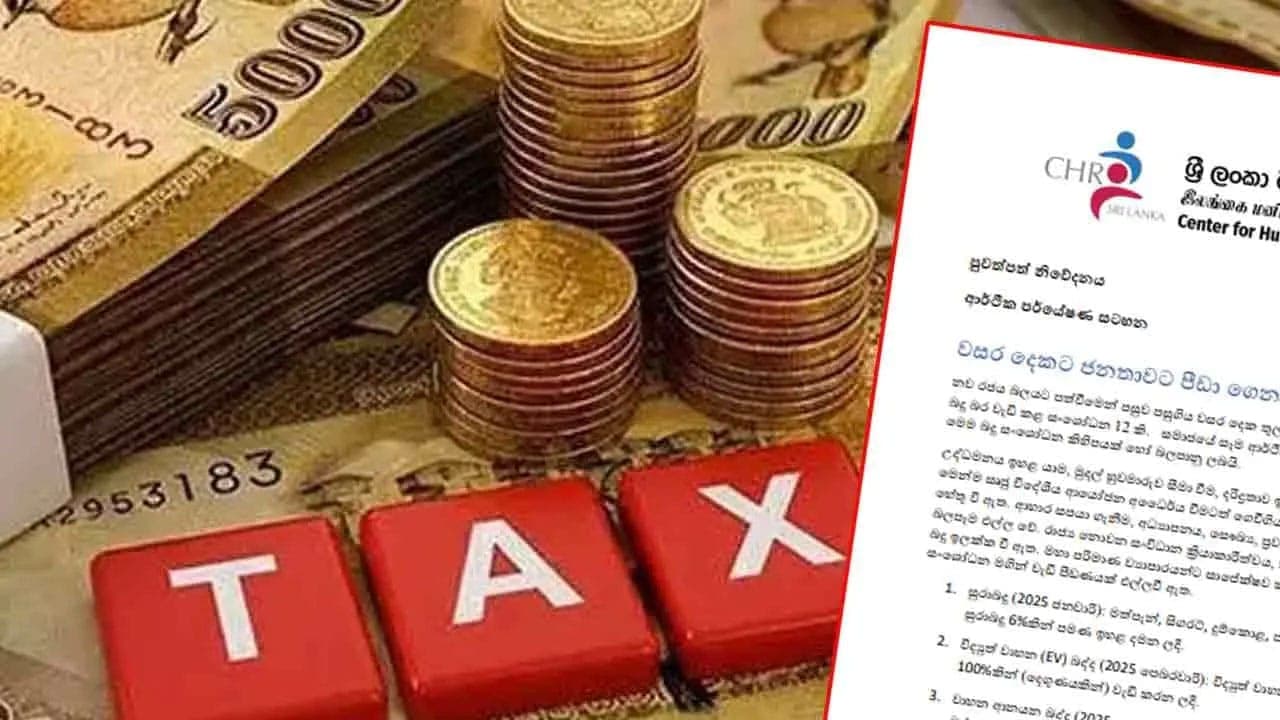


The Sri Lanka Center for Human Rights and Research (CHR Sri Lanka) has revealed that the present government has introduced 12 tax revisions over the past two years, claiming that several of these measures have placed an additional burden on the public.
In a statement, the Centre said the tax amendments had affected people across different economic sectors and income levels, with at least some of the revisions impacting almost every segment of society.
The statement further claimed that the new tax measures had contributed to rising inflation, restricted financial transactions, increased poverty, declining investment and discouraged foreign investment.
The Centre also highlighted the impact of the tax revisions on essential areas, including food supplies, education, healthcare, transportation and online businesses.
According to the organisation, non-governmental organisations and small and medium-sized enterprises (SMEs) have also been affected by the changes. It noted that SMEs had come under greater financial pressure compared to larger businesses.
The 12 tax revisions identified by the Centre include:
1. Excise Duty – January 2025: An approximately 6% increase in excise duties on liquor, cigarettes, tobacco, sweetened beverages and motor vehicles.
2. Electric Vehicle Tax – February 2025: A 100% increase in excise duty rates applicable to electric vehicles.
3. Vehicle Import Tax – February 2025: The removal of existing customs duty exemptions and the introduction of a 20% import duty, together with an additional surcharge, according to the Centre.
4. Withholding Tax (WHT) – April 2025: An increase in withholding tax on bank deposit interest from 5% to 10%, with relief available to eligible low-income earners through self-declarations.
5. Corporate Income Tax – April 2025: An increase in the tax rate from 40% to 45% for companies engaged in liquor, tobacco, betting and gambling businesses.
6. Service Export Tax – April 2025: The introduction of income tax of up to 15% on service exports and income derived from foreign sources that were previously exempt.
7. Customs Import Duties – April 2026: Changes to the existing customs duty structure, introducing new tax categories of 0%, 10%, 20% and 30%, with the highest rate applying to selected imported goods.
8. Social Security Contribution Levy (SSCL) on Vehicles – May 2026: The introduction of a 2.5% Social Security Contribution Levy on vehicle imports.
9. Additional Vehicle Import Duty – May 2026: The imposition of an additional 50% surcharge on the existing 30% customs duty, bringing the overall rate to 45%, with the measure extended until December 31, 2026.
10.Capital Gains Tax – June 2026: An increase from 10% to 15% for individuals and partnerships, and from 10% to 30% for trusts, mutual funds and non-governmental organisations.
11. Withholding Tax on Professionals – June 2026: The introduction of a 5% withholding tax on monthly earnings exceeding Rs. 100,000 for professionals, including photographers, artists, IT specialists and social media experts.
12. VAT on Digital Services – July 2026: The introduction of an 18% Value Added Tax (VAT) on digital services provided by foreign companies not registered in Sri Lanka, although its practical implementation has yet to be fully completed.
The Human Rights Centre has called on the government to pay greater attention to the impact of taxation on essential sectors when formulating the upcoming Budget.
In particular, it stressed the need for targeted tax revisions in areas affecting public nutrition and food supplies, healthcare, including medicines and medical equipment, education, including school supplies, and industries such as fisheries, agriculture and raw material production.