




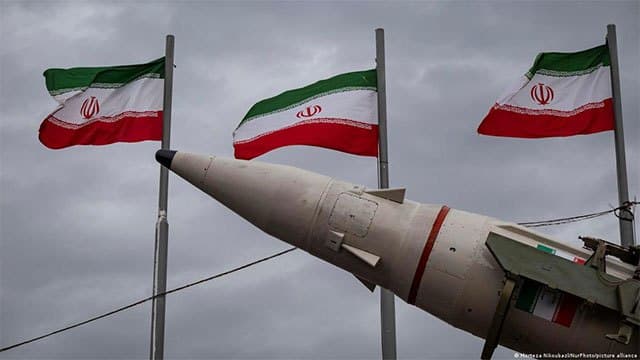



Iran has vowed to retaliate against to widened U.S. sanctions, saying Washington should “expect an attack” in response to the measures.
“We know how to play the game too,” Iran’s Economy Minister Ali Madanizadeh said in an interview televised by state media late Monday as he condemned the U.S. measures an “economic terrorist attack.”
The U.S. has imposed sanctions on Iran since 1979 after Iranian students stormed the American embassy in Tehran, taking U.S. diplomats hostage.
Madanizadeh added that at least two nations — China and Russia — have so far given no indication that they plan to fall into line.
On Tuesday, CIA Director John Ratcliffe flew unannounced to Russia to holds talks in Moscow, according to a person with knowledge of the matter. The person declined to say who Ratcliffe was meeting with or the focus of the talks. The CIA declined to comment.
At a news conference Tuesday, Chinese Foreign Ministry Spokesperson Lin Jian said Beijing was firmly opposed to “illegal unilateral sanctions,” according to Xinhua, China’s state-run news agency.
Madanizadeh warned that “they should not think that our response will be defensive and that we will only defend ourselves.” He added: “They should expect an attack from our side as well.”
He did not specify what sort of attack he was referring to.
He added that Tehran had been preparing for such an economic assault and had a two-year plan in the works to deal with the impact, though he did not expand on that strategy.
The comments came after U.S. Treasury Secretary Scott Bessent on Monday announced the fresh battery of measures against Iran, which he dubbed an “economic D-Day,” warning that any nation financially partnering with Tehran would be isolated. The U.S. stopped short of imposing actual penalties.
Bessent provided limited details on the measures and did not identify countries that could be targeted with secondary sanctions, but he said President Donald Trump was “making phone calls to world leaders with specific requests to cease their interactions with the regime.”
The U.S. Department of the Treasury confirmed in a news release Monday that it had launched “Operation Economic Outcast.” In a news release it said it was expanding the categories of Iran-related conduct that could be subject to secondary sanctions in the future, with determinations issued against “five critical sectors — digital assets, technology, gold, aviation, and shipping.”
It added that the Office of Foreign Assets Control had also sanctioned nearly 60 entities, individuals and vessels in multiple jurisdictions that it said “enable the Iranian regime’s recklessness,” in addition to other measures.
The operation’s launch came after the United Arab Emirates, which has long maintained close economic ties with Iran, last week announced it would be halting all financial transactions with Tehran.
On the ground in Tehran, some Iranians expressed resignation at the U.S.’s announcement, which Bessent described as “the single greatest financial offensive ever” against Iran.
“It’s nothing new,” one man, Farzin, a 27-year-old mechanic told NBC News on Tuesday. “The country is already locked and the psychological effect is worse than the actual outcome.”
Farzin said U.S. sanctions had yet to yield any significant impact on his business, with car parts still making their way into the country.
“You find a route and you find a market inside the country,” he said, adding that many parts were being imported through the country’s land borders, whether legally or illegally.
Farzin declined to give his last name. Many Iranians are wary of speaking with and identifying themselves to U.S. media.
Hamid Ebrahimi, a retired lawyer and university professor, said many Iranians felt there was little they could do to make their lives any better.
“We are just getting by day to day and can’t keep up with inflation,” said Ebrahimi, 63. “Sanctions have had an effect and the government says it can manage them, but they have always hurt the people and they will continue to do so.”
Andreas Krieg, a senior lecturer at King’s College London’s School of Security Studies, said the latest moves from Washington were unlikely to achieved the desired results.
“Iran’s response so far suggests Washington’s ‘Economic D-Day’ is producing pain, but not the behavioral effect the administration is looking for,” he said.
Tehran appeared to be interpreting the measures as “economic warfare” aimed at its “regime survival rather than as bargaining pressure designed to produce a compromise,” Krieg added.
As a result, its response “has consequently been defiance rather than accommodation.”
Iran’s President Masoud Pezeshkian said in comments published by the semiofficial Tasnim news agency on Monday that the U.S. “must correct its tone and approach in dealing with Iran, because relying on force and bullying will only complicate the process.”
Krieg said the global community could expect Tehran to increase pressure on the Strait of Hormuz, the crucial trade route through which some 20% of the world’s oil once ran before the war, which began in late February after the U.S. and Israel launched punishing strikes on Iran.
The stated reason for waging war was preventing Iran from building a nuclear weapon. Tehran has long denied it is seeking to build a nuclear arsenal.
Since then, the key waterway has largely been strangled by a blockade imposed by Iran, sending energy prices soaring, with the U.S. also launching its own blockade in Iranian ports in response to Iranian attacks along the strait. Hormuz was open and without tolls when the U.S. and Israel triggered the war.
“Tehran cannot prevent Washington from imposing sanctions, but it can make those sanctions expensive for everybody else,” Krieg said.
Meanwhile, Iranian media have repeatedly aired content threatening the life of Trump’s son Barron Trump, fueling fears over the escalating rhetoric surrounding the conflict.
U.S. Secret Service spokesperson Nate Herring said Monday that the agency was “aware of the video and investigates anything that can be perceived as a threat toward our protectees.”
“Out of concern for operational security, we do not discuss matters of protective intelligence,” Herring added.
– with Agencies inputs --