







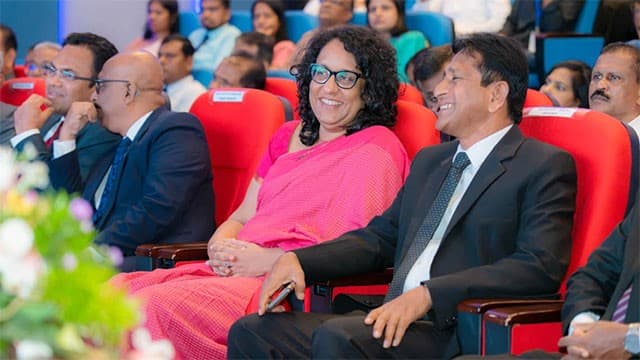



Prime Minister Dr. Harini Amarasuriya stated that the new National Youth Policy, being formulated to address the current challenges faced by Sri Lanka’s youth and fulfil their aspirations for the future, is scheduled to be finalised and implemented by the first quarter of 2027.
The Prime Minister made these remarks on September 16, while addressing the 1st National Research Symposium on Youth Development – NRSYD 2026, jointly organised by the Open University of Sri Lanka (OUSL) and the Ministry of Youth Affairs and Sports, held at the Water Supply and Drainage Board Auditorium in Ratmalana, according to the Prime Minister’s Media Division.
The symposium was held under the theme, "Young People as Right Holders and Change-Makers: Asset-based Pathways for Social Transformation.” Research papers are being presented under nine key thematic areas.
These areas include youth empowerment and leadership; education, vocational training and skills development; health, mental well-being and nutrition; youth entrepreneurship and economic participation; technology, digitalisation and innovation; climate change and sustainable development; minorities, social integration and the rule of law; youth migration and international relations; and arts, culture and creative expression.
The official publication of the symposium was presented to Prime Minister Dr. Harini Amarasuriya and other distinguished guests by Deputy Minister of Youth Affairs and Sports Mr. Dinindu Saman Hennayake and Secretary to the Ministry Mr. A.M.H.U. Aruna Bandara.
Speaking at the event, Prime Minister Dr. Harini Amarasuriya sated:
“Although a draft National Youth Policy was prepared in 2014, it was not implemented. Therefore, a new policy is currently being formulated with the participation of all stakeholders, taking into consideration the current changes in technology, the economy and the employment market.
Under the Government’s Public Investment Programme, Rs. 145 million has been allocated for research and development activities in the youth and sports sectors. Rs. 5 million has been allocated for this symposium. This allocation is a good beginning. It clearly demonstrates the seriousness with which we view evidence-based policymaking.
In the face of technological advancement and digitalisation, providing young people with academic knowledge alone is not sufficient. It is essential to equip them with practical, technical and vocational skills alongside knowledge. For this purpose, curricula within the existing education system must be updated in line with new technologies and global demand.
As for the Government, youth development is a cross-cutting issue that concerns all sectors. Our intention is to establish a unified policy framework that can provide guidelines and recommendations to address the challenges faced by young people in a scientific and sustainable manner.
Formulating a policy is only the beginning. The success of the National Youth Policy will depend on its implementation, monitoring and evaluation. Our objective should be to develop young people who are resilient and capable of facing changes, while also enabling them to become a generation that leads positive changes taking place in the world.”
The Prime Minister further stated that there is a proposal to hold the research symposium as an international conference next year, which would provide Sri Lankan researchers with significant opportunities to establish connections at regional and international levels, it added.
The occasion was attended by the Minister of Youth Affairs and Sports Mr. Sunil Kumara Gamage, Vice Chancellor of the Open University of Sri Lanka Senior Professor P.M.C. Thilakarathne, along with a large number of researchers, academics and young people.