









The Supreme Court is scheduled to take up tomorrow (01) the petitions challenging the constitutionality of the proposed 22nd Amendment to the Constitution, which was presented to parliament by the government recently.
A five-member Supreme Court bench has been appointed to hear the petitions, with Chief Justice Preethi Padman Surasena serving as its head.
The other members of the bench include Justices Achala Wengappuli, Arjuna Obeyesekere, Sampath Abeykoon and Gihan Kulatunga.
The petitions challenging the proposed constitutional amendment are expected to be taken up before the five-member bench tomorrow.
Several petitions filed against 22nd Amendment
The proposed 22nd Amendment has faced a series of legal challenges since it was presented to parliament.
Accordingly, nearly 30 petitions have been filed before the Supreme Court, both challenging and supporting the proposed amendment. The deadline for filing such petitions ends today.
Opposition political parties, the Bar Association of Sri Lanka (BASL), several other lawyers’ organisations and civil society groups are among those who have challenged the Bill.
Petitions have also been filed in support of the proposed amendment, including one by National People’s Power (NPP) Member of Parliament Lakshman Nipuna Arachchi.
The supporting petition argues that the provisions of the Bill do not violate the sovereignty of the people or the independence of the judiciary and that the proposed legislation can be enacted through the parliamentary process without a referendum.
What is the 22nd Amendment?
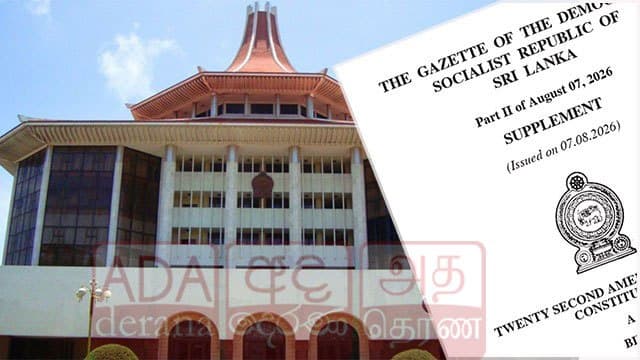
The 22nd Amendment to the Constitution was presented to Parliament on August 18, 2026, by Minister of Justice Harshana Nanayakkara.
The proposed constitutional amendment has been introduced by the government as part of reforms aimed at strengthening the independence and efficiency of the country's judicial system.
The Bill was first published in the government gazette on August 7.
One of its key provisions proposes increasing the mandatory retirement age of Supreme Court judges from 65 to 67 years. The retirement age of Court of Appeal judges would also be increased from 63 to 65 years.
The proposed amendment further provides that the Chief Justice would retire upon reaching the age of 67 or completing six years in office, whichever occurs first.
The government has stated that the proposed changes are intended to strengthen the judiciary and improve the efficiency of the judicial process, including by helping address the backlog of cases.
Concerns over judicial independence
The proposed changes have triggered significant debate among legal professionals, opposition political parties and civil society organisations.
The Bar Association of Sri Lanka has strongly opposed the proposed amendment in its present form, raising concerns over the possible impact of extending the retirement age of judges on judicial independence and public confidence in the judiciary.
Attorney-at-Law Lal Wijenayake has also challenged the proposed amendment before the Supreme Court, arguing that the Bill requires approval by the people at a referendum.
A separate petition filed by the Lawyers for Democracy organisation has similarly asked the Supreme Court to determine that the proposed amendment is inconsistent with Article 3 of the Constitution and therefore requires approval at a referendum.
Meanwhile, the government has indicated that it is prepared to comply with any determination made by the Supreme Court regarding whether a referendum is required.
Supreme Court determination
The Supreme Court's consideration of the petitions will determine the next constitutional and parliamentary steps concerning the proposed 22nd Amendment.
Under Sri Lanka's Constitution, challenges to a Bill can result in the Supreme Court determining whether provisions are inconsistent with the Constitution and, where applicable, whether special parliamentary approval and/or approval at a referendum is required.
The five-member bench headed by Chief Justice Preethi Padman Surasena is therefore expected to consider the various legal challenges when the petitions are taken up tomorrow (01).